5 No-Prep Thanksgiving Activities

Looking for ready-to-use Thanksgiving activities that keep students engaged in learning? You’ll be thankful for these 5 easy activities:

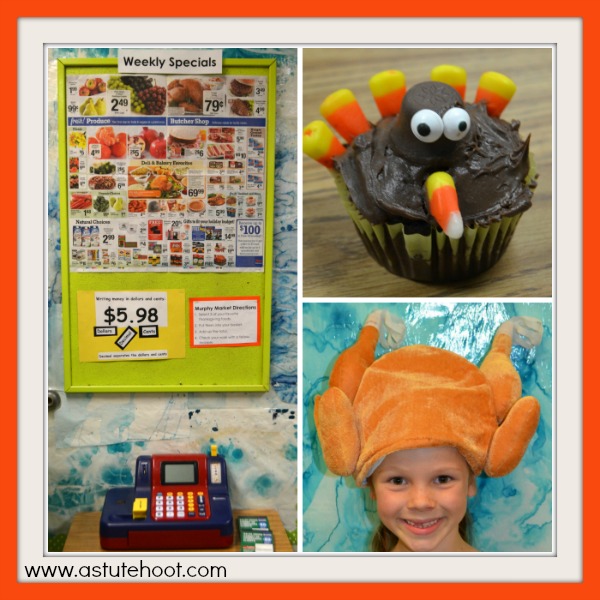
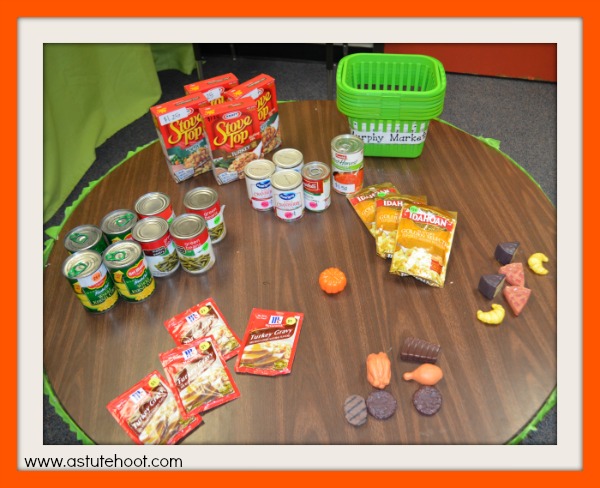
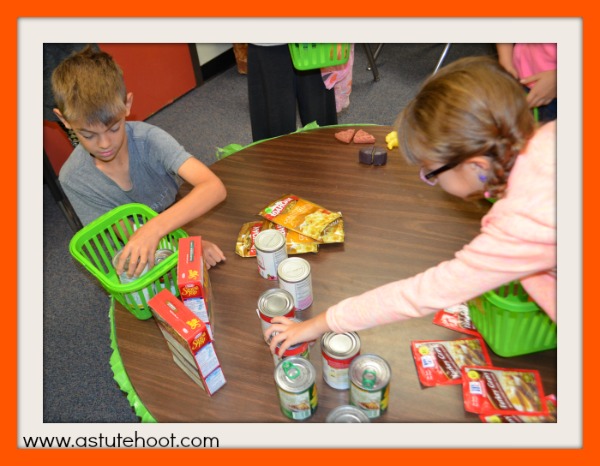
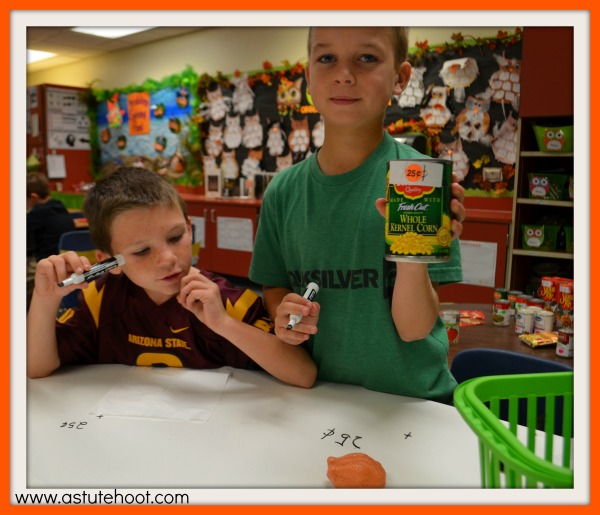
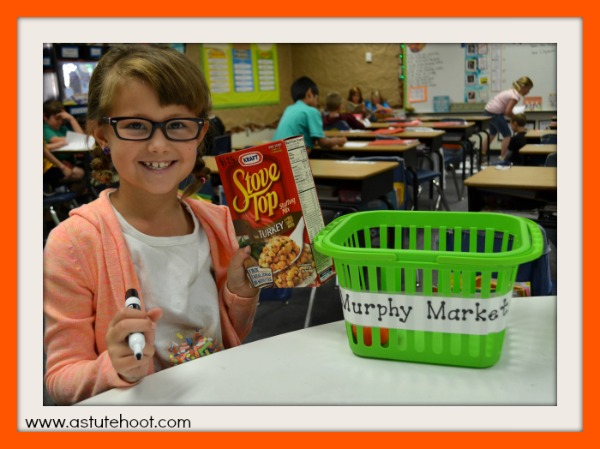
1. Create A Classroom Market: Murphy Market is a center I created in which students purchase items, add totals and learn to make change. To create this center, I purchased several inexpensive Thanksgiving canned food items and priced according to my students’ academic needs. Since we are working on counting quarters, I priced most items in increments of 25.

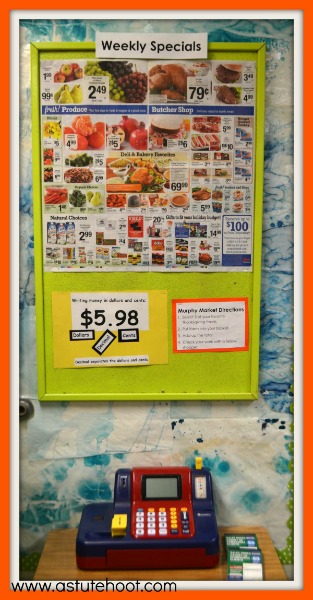
Murphy Market 3 I scoured my local Dollar Store for market supplies and found these adorable shopping baskets, play food, price stickers and receipt books. I posted weekly grocery specials (be sure to avoid alcohol and other inappropriate items) along with specific directions for the center.

Murphy Market 4

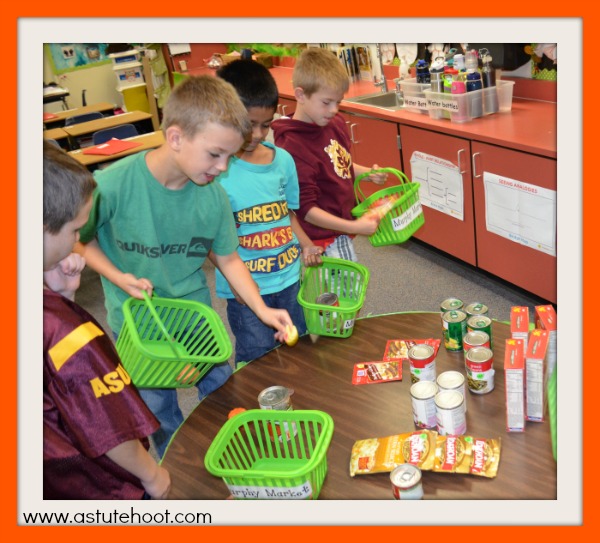
At Murphy Market, students shop for 2-4 Thanksgiving items. I scaffold the number of purchases based on instructional needs; my proficient mathematicians shop for 4 items while my developing mathematicians shop for 2 items.

Murphy Market 2

Murphy Market 5

After selection, students come over to my whiteboard table and we take turns adding up totals. Each shopper takes a turn to show items and name prices while all students play cashier, adding up totals. This keeps students engaged and provides multiple opportunities for mathematical practice. We compare strategies and answers and then move to the next shopper.

Murphy Market 6

Murphy Market 7

I change pricing and weekly specials regularly and rotate items seasonally. After Thanksgiving, I will set up a holiday boutique full of Dollar Store holiday gifts.

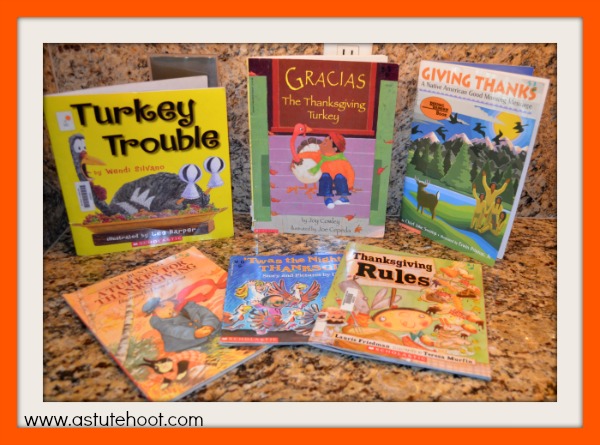
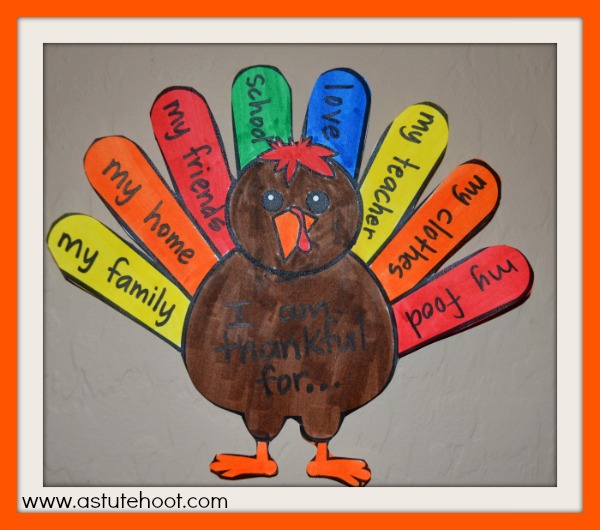
2. Record Thankful Thoughts: Generate excitement about Thanksgiving and help students realize all of the things they are thankful for with this fun craft. Read and discuss one of the books below.

Thanksgiving books

Then students assemble the turkey and write what they are thankful for on the turkey feathers. Download this FREE craft here. Check out our Thanksgiving Writing With Icons and Sentence Frames for additional Thanksgiving writing activities.

Thankful Thoughts

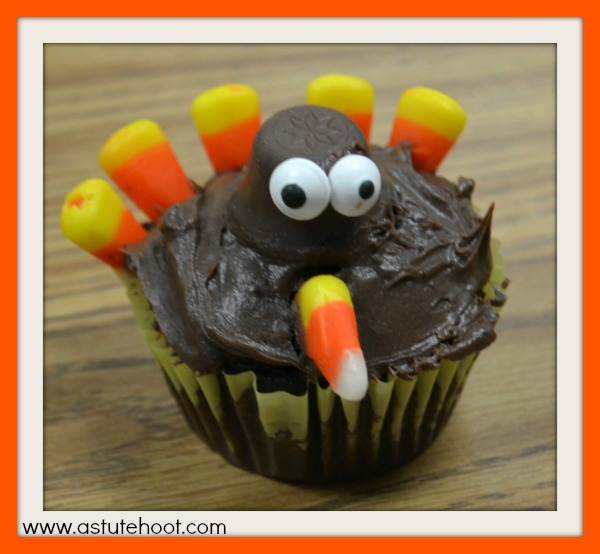
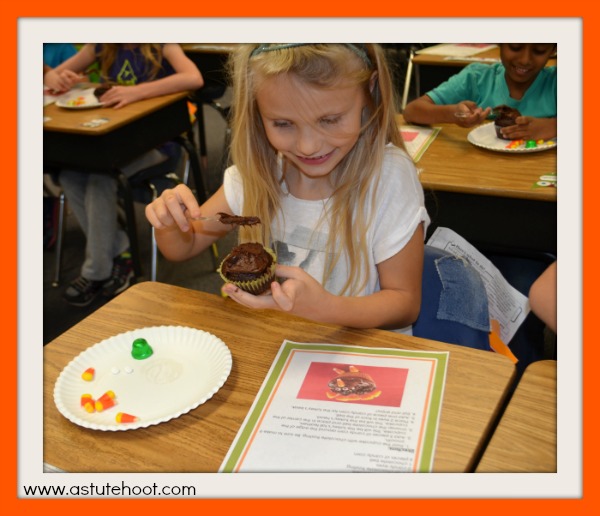
3. Make Turkey Cupcakes: Students love classroom cooking projects and this Turkey Cupcake recipe is one of their favorites!

turkey cupcake 1

You need plain, chocolate cupcakes, chocolate bells (found at Dollar Store), candy corn, chocolate frosting and Wilton candy eyes (found at Target’s baking aisle near the sprinkles). Students will gather ingredients, read the recipe (functional text) and eat and enjoy them. Download complete recipe here.

Turkey cupcake 2

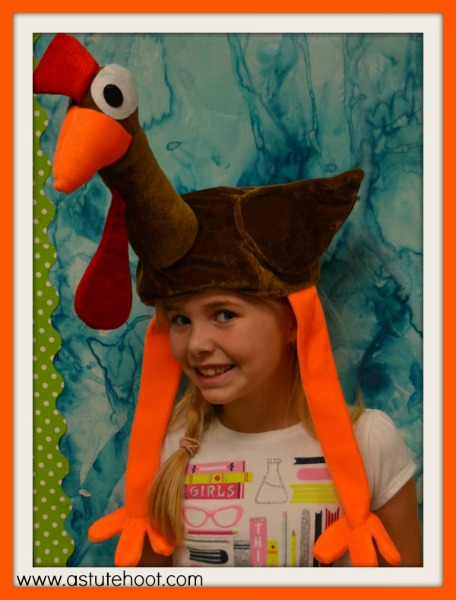
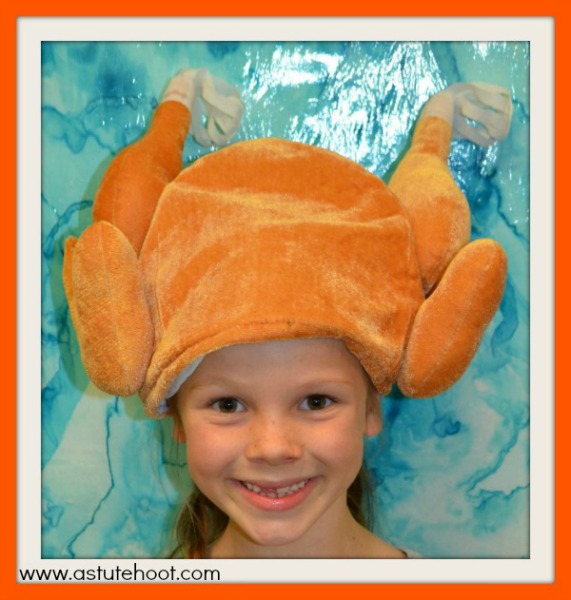
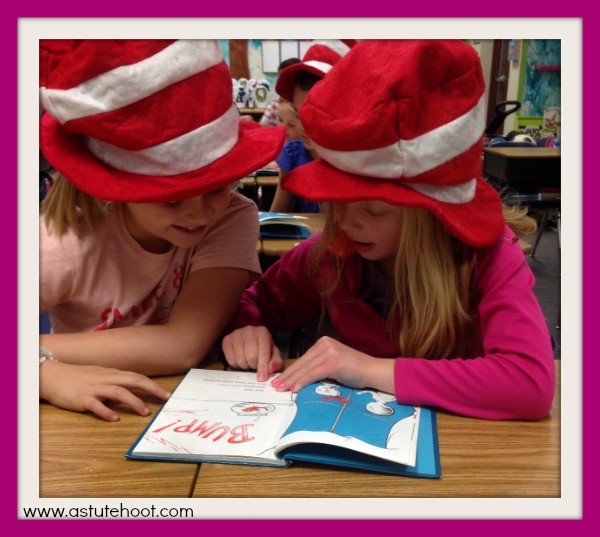
4. Pose for Turkey Portraits: I found these adorable turkey hats in the dollar section of my local Target. I let students pick their hat of choice and then use them to make Thanksgiving cards. You can also use them for turkey acrostic poems, descriptive writing or Thanksgiving recipes.

Turkey hat 1

turkey hat 2

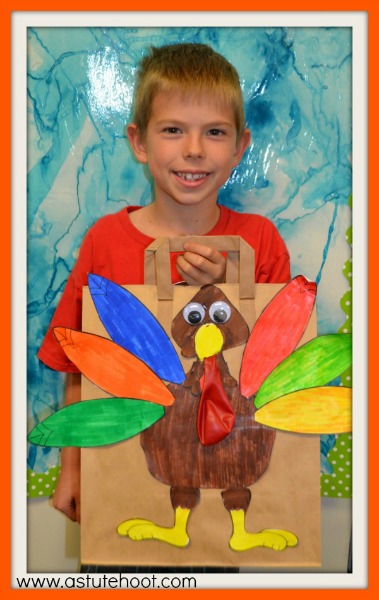
5. Create Turkey Bags: These cute turkey bags organize and house all of students’ Thanksgiving projects. Simply pick up a class set of brown grocery bags and have students make a turkey on the front. You can use our free downloadable turkey graphic or any other turkey pattern. My students add a red balloon for the gobbler and large googly eyes to add character to each turkey.

Turkey bag

Jessica_blog_signature-SMALL


Guided Reading Survival Guide Part 3

In part 1 and part 2 of my Guided Reading Survival Guide blog series, I explained how teachers must go beyond the basal and provide authentic, high-quality supplemental texts ranging in genre and teach research-based reading strategies using our cast of animal characters.guided

Guided Reading Survival Guide: Using Hands-On Tools

It’s time to put the strategies we discussed in the previous blog into students’ hands–literally. Hands-on tools motivate and engage students and make practice fun. Each of our strategy animals has an accompanying hands-on tool. Students associate animals with comfort, safety, and play and when animals are personified, students readily understand and apply the lessons and messages from the animals. Just yesterday, I was doing a fact assessment. I always remind students to double-check their answers, but they often need several reminders to do so. Yesterday I got out my Fiona Fact Fluency Fox puppet and had Fiona remind the kids about double-checking. What do you know? They all double-checked their answers.


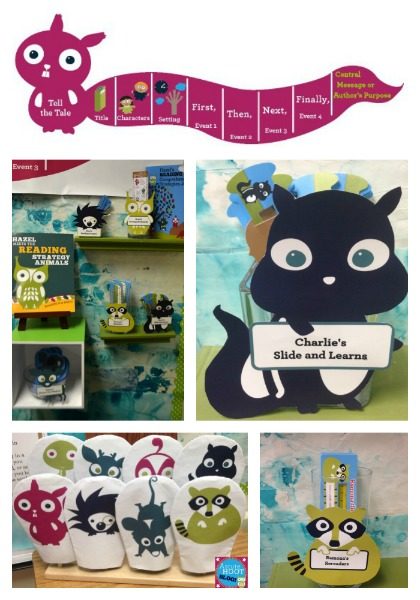
Each of the hands-on tools is displayed in the classroom; most are in clear, inexpensive glass jars with the animal label glued to the front. They make a cute display and are easily accessible.

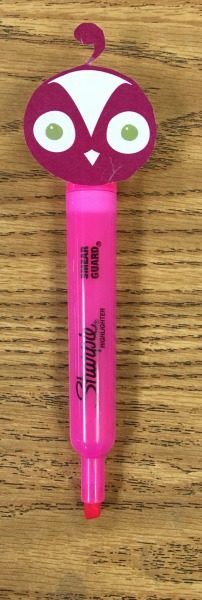
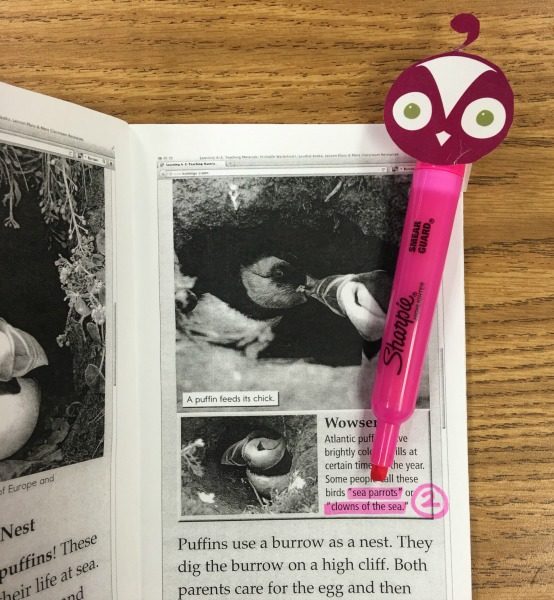
hands-on-tool-collageIn my classroom: Since students used Quinn the Questioning Quail to use textual evidence to answer questions, I created a set of Quinn’s Quills. I purchased fuchsia highlighters from Amazon (to match Quinn’s color), printed, laminated, and cut out a set of Quinn’s heads, available in the Quinn Questioning Quail unit. I glued the heads to the highlighters. The head looks like it’s upside down when the marker is closed, but this protects the head and the topnotch.

highlighter-open

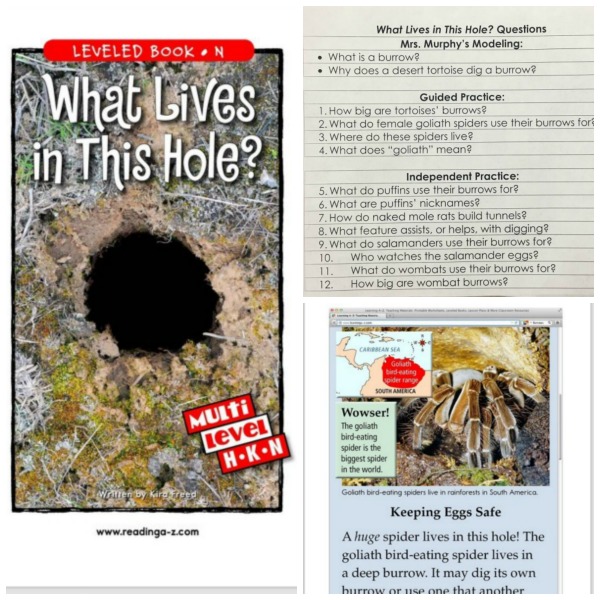
Before the lesson, I enlarged and laminated my copy of  “What Lives in This Hole?”, my guided reading text from Reading A-Z. The larger format allows all students to easily see the text and the lamination allows me to reuse it each year.

text-dependent-questions

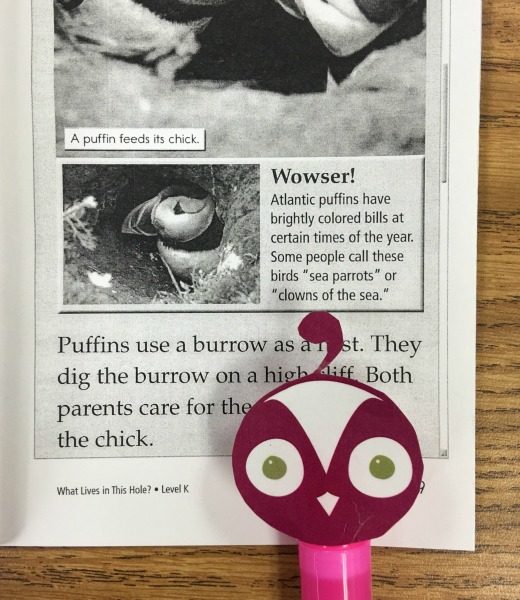
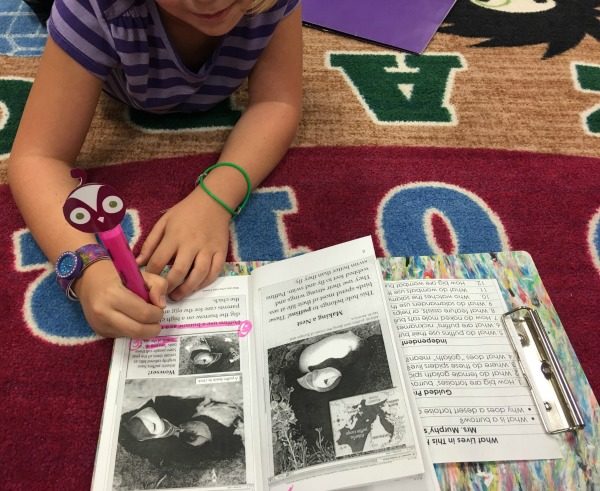
During the lesson, I modeled how to answer each question in the I Do section, thinking aloud as I went. I demonstrated how to use Quinn’s question mark topnotch to first point to the answer, then highlight it and write the question number next to it. We then practiced the strategy together by answering the questions in the We Do section. Students pointed to the answer with Quinn’s topnotch. Before we highlighted, we discussed each student’s response to ensure that everyone was on track. Finally, we highlighted the answer.

quinn-pointerquinn-highlighter

Students absolutely LOVED Quinn’s Quills and asked to use them during whole group reading time as well. Unfortunately, our basals can’t be highlighted, but this is another benefit of using Reading A-Z printable books.

quinn-in-use

Check out the full line of reading and math hands-on tools. You students will LOVE them, too!

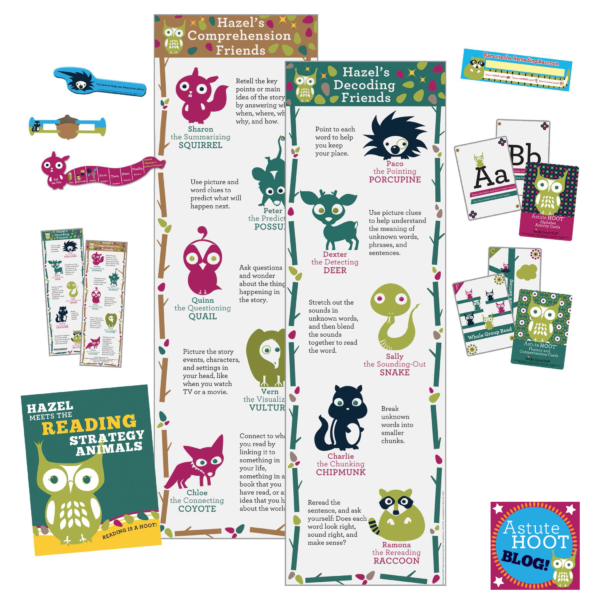
hands-on-toolsCheck out tomorrow’s blog to learn how to integrate multiple strategies during guided reading time.

Jessica_blog_signature-SMALL


Guided Reading Survival Guide Part 2

Yesterday in part 1 of my blog series, Guided Reading Survival Guide, I explained how teachers must go beyond the basal to provide several authentic, high-quality supplemental texts ranging in complexity and genre to promote a deeper understanding of content. In part 2 of the series, I will explain how to select research-based strategies for guided reading groups.

guided

Guided Reading Survival Guide Part 2: Selecting Strategies

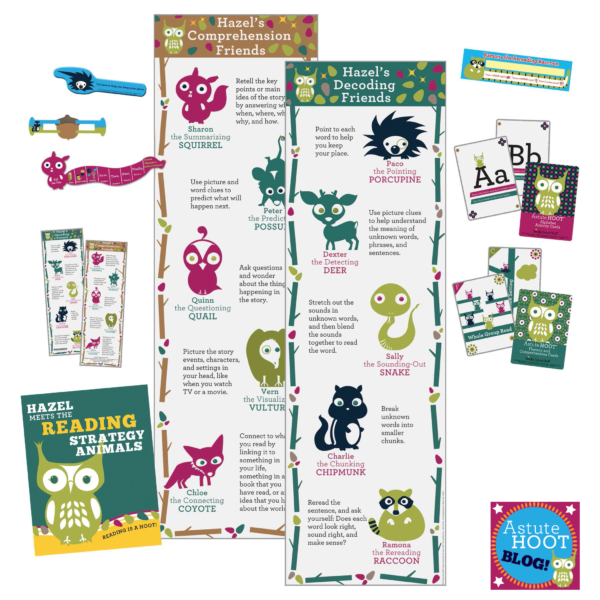
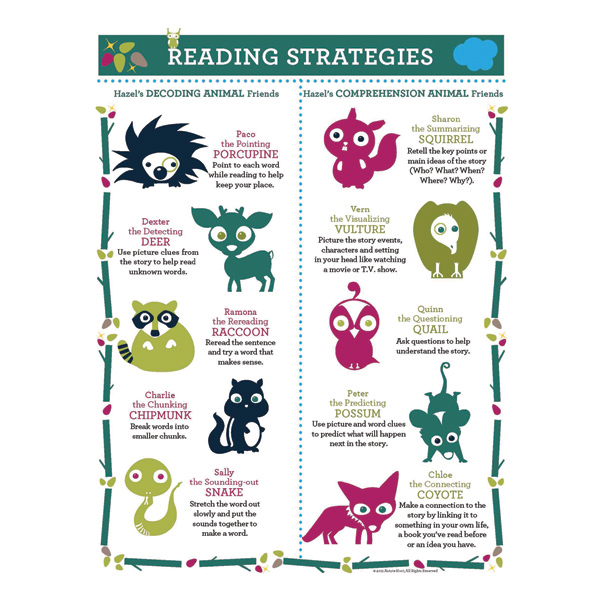
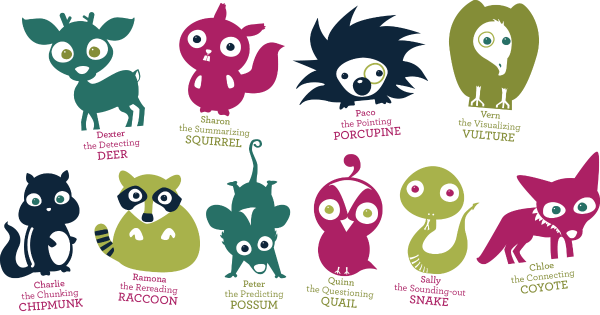
Now that I have broken the bond with the basal, let’s talk strategy. My students used to struggle with transferring and applying learned strategies across settings, curricula, and various genres of authentic text. I partnered with Jennifer Zoglman, a veteran special educator, and her sister, Tina Rataj-Berard, an award-winning graphic designer, to create a unique cast of strategy animals that make learning safe and fun while teaching critical strategies in an engaging way. Each animal teachers a research-based strategy using a short, rhymed poem and child-friendly language.

Reading Strategies Poster_web

Animals were specifically chosen because animal characters are present in children’s lives from the very beginning in toys, books, and cartoons. Children learn to associate animals with comfort, safety, and play. When animals are personified, children readily understand and apply the lessons and messages from the animals. Brain research shows that when material is presented in a novel way, it ignites curiosity and interest in learning new topics and leads children to readily grasp and internalize the information.

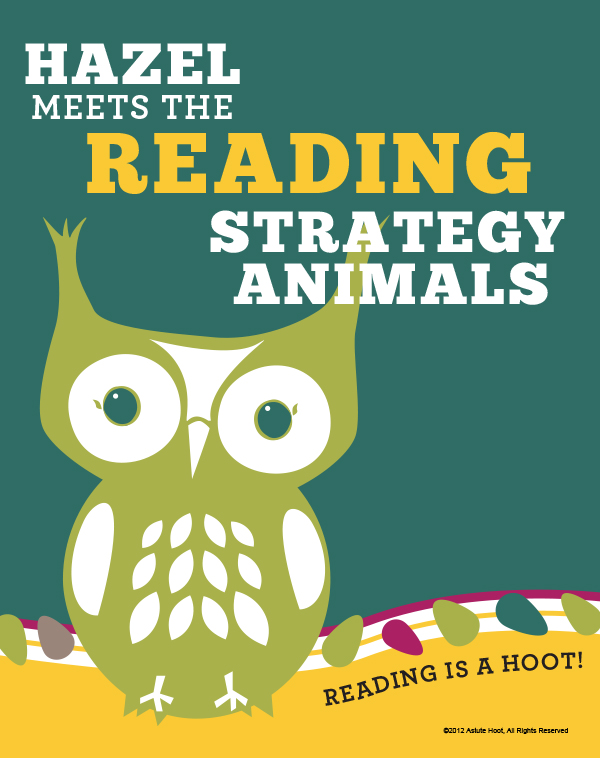
Students first meet the strategy animals in the read-aloud, “Hazel Meets the Reading Strategy Animals.”  Hazel Hoot, an adorable green screech owl, is a struggling learner as she lacks the strategies needed to help her succeed. Hazel stumbles upon a magical tree in the forest. Out of the tree appear 10 colorful woodland animals that each introduce a reading strategy. These animals guide Hazel to become a proficient reader.

reading book banner

Students in all academic settings make an immediate connection with the animals and love to practice new strategies using the animals’ special tools. Read more about how animals help children learn here. Meet our complete line of strategy animals here. Watch this short video to see our strategy animals in action.

In my classroom: I select one comprehension strategy animal to use for both whole group and small group instruction. This strategy animal is introduced and modeled as we read the basal during whole group time. I use the same strategy animal during guided reading groups where students can practice and apply the strategy within leveled text.

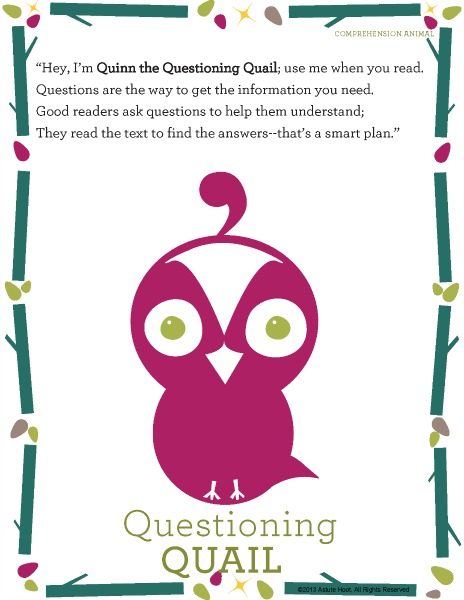
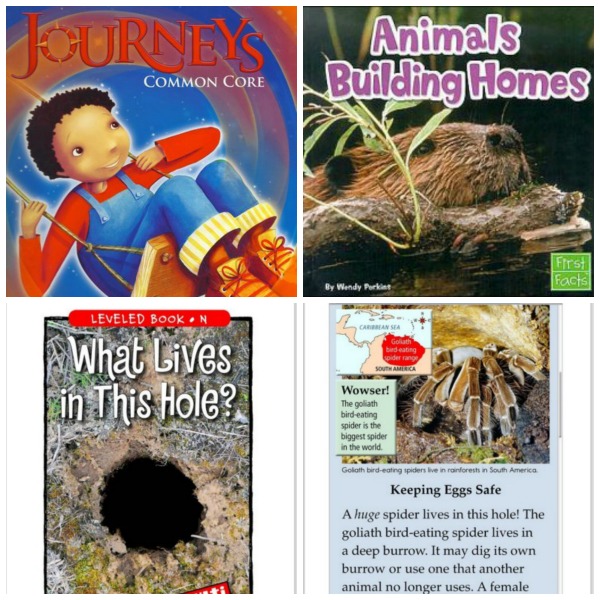
In the Journeys basal text, “Animals Building Homes” the strategy was to answer questions in the text. I selected Quinn the Questioning Quail as the focus strategy animal. I read through the text and wrote a list of text-dependent questions, separating them into 3 categories: I Do, We Do, You Do.

quinn-poem

I did the same thing for my guided reading text, “What Lives in This Hole?”, a multi-level book from Reading A-Z. Since this was the first lesson on this strategy, I created only text-dependent questions where the specific answer was clearly stated in the text. As students become proficient with answering specific text-dependent questions, I will incorporate questions that require students to use inference skills as well.

text-dependent-questions

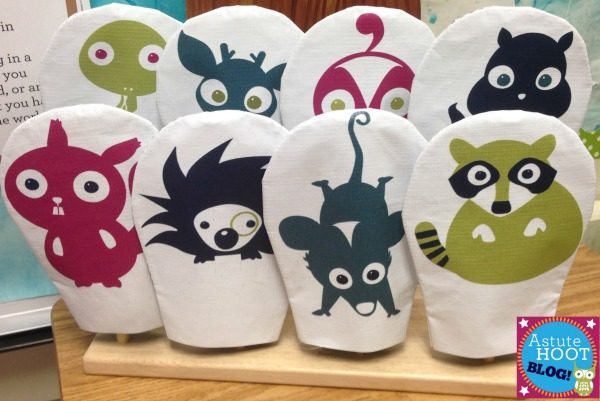
I use puppets to introduce the strategy animals. The students always greet the animal and then I read the poem which explains the strategy in a child-friendly way. Many students actually believe that the animals are real and often go home and tell their parents all about them. Tying the animals to strategies makes learning more concrete and helps students effectively apply and transfer across settings.puppets

Read tomorrow’s blog, Guided Reading Survival Guide Part 3: Incorporating Hands-On Tools to see how students practice the strategies in a motivating, engaging way. Be sure to read part 1 of the Guided Reading Survival Guide: Going Beyond the Basal.

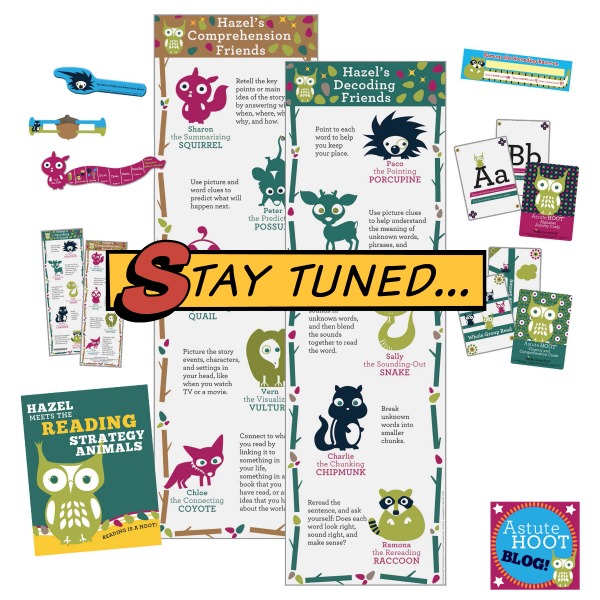
hands-on-tools-stay-tunedJessica_blog_signature-SMALL


Guided Reading Survival Guide Part 1

Guided reading can be daunting, especially with the new instructional shifts and standards. Teachers are asking themselves such questions as: “What texts do I use?” “What strategies do I teach?” “How do I motivate and engage?” “How do I integrate multiple strategies?”

As educators with a combined total of almost 30 years spend in early childhood and special education, Jennifer and I have cultivated four instructional practices that incorporate our effective animal-based curriculum to maximize guided reading time. Read our four part blog series that outlines these practices and show how students enthusiastically embrace them.

guided

Guided Reading Survival Guide Part 1: Going Beyond the Basal

Most teachers are required to use district-prescribed curricula, which often includes a basal and a series of leveled readers, many of which are dry and designed to fit the weekly basal skills. The basal can be used as an anchor text, but it should not stand alone. Provide several authentic, high-quality supplemental texts ranging in complexity and genre to promote a deeper understanding of content.

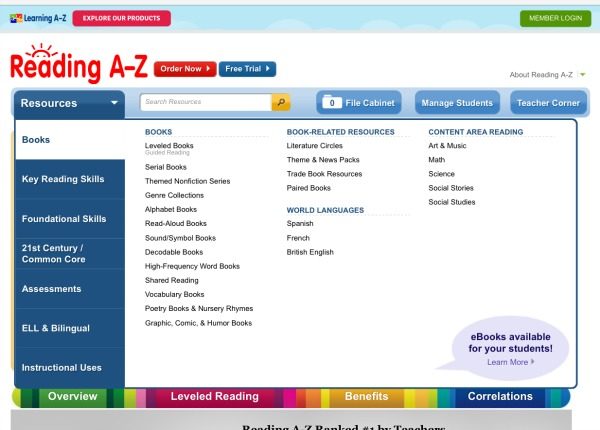
Reading A-Z is the ideal resource because its vast library of more than 2,500 downloadable books allows teachers to search by strategy, skill, or topic, making differentiation much easier. Several titles are part of a multi-level series, making quality content available to all readers. Plus, the printable books allow students to practice test-taking strategies, such as highlighting answers in the text, while using authentic text rather than mundane practice tests or contrived passages.

reading-a-z-books

In my classroom: I select Reading A-Z books that complement the weekly basal story, complement the current science unit, or focus on a specific reading strategy that I am teaching. In a recent unit, I chose, “What Lives in This Hole?” because it aligned to our Journeys basal story, “Animals Building Homes.” This was a great supplement to deepen student understanding, apply learned strategies, and build academic vocabulary.

supplemental-collage

Tomorrow check out part 2 of our Guided Reading Survival Guide blog series to see how I incorporate various reading strategies across multiple texts.

Astute Hoot's Reading Strategy Animals


Jessica_blog_signature-SMALL


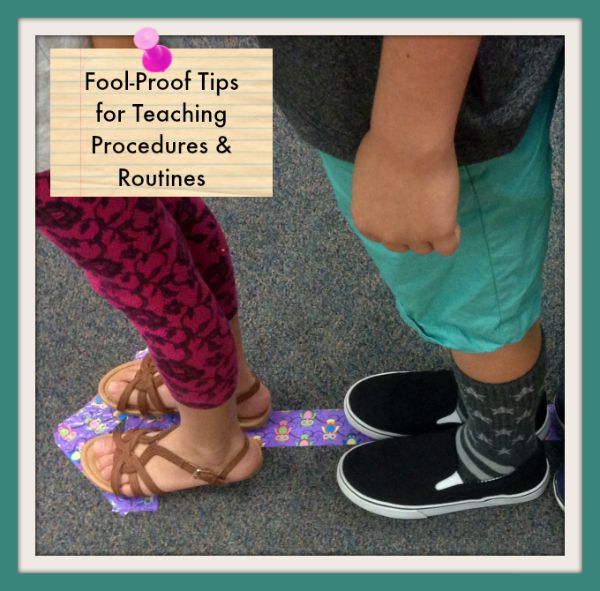
Fool-Proof Tips for Teaching Procedures & Routines

You know that feeling of excitement you feel when you spot a cute new idea on Pinterest? Those all-too-familiar thoughts run through your mind. “It looks so easy, there aren’t that many materials, how hard could it be?” Yet despite your best intentions (and a few hours of your life you’ll never get back), you experience that dreaded Pinterest fail.

Just like that cute Pinterest project, we all start the new school year with the best intentions and high expectations.  However, the beginning of the year can evoke that same dreaded Pinterest fail feeling. I remember thinking, “Why aren’t students listening to me? Why can’t they unpack quietly? Can’t they just sit at the carpet? I’m telling them to do these things, but they aren’t.” What I failed to realize is that I wasn’t teaching students how to perform these routines and procedures and I was setting myself up for failure.

Those wonky Pinterest cupcakes can easily be thrown in the garbage and remade, but those first few days are the most valuable time in the whole school year. This precious time shapes expectations, behaviors, and routines for the rest of the year. Invest up front with practicing key procedures during the first few weeks of school and this investment will be returned to you tenfold throughout the year. Students will clearly understand expectations, behavior problems will be eliminated, and instructional time will be maximized. Nail those first few days using 3 of our tried-and-true, fool-proof tips for teaching key procedures and routines.Fool-Proof Tips for Teaching Procedures & Routines
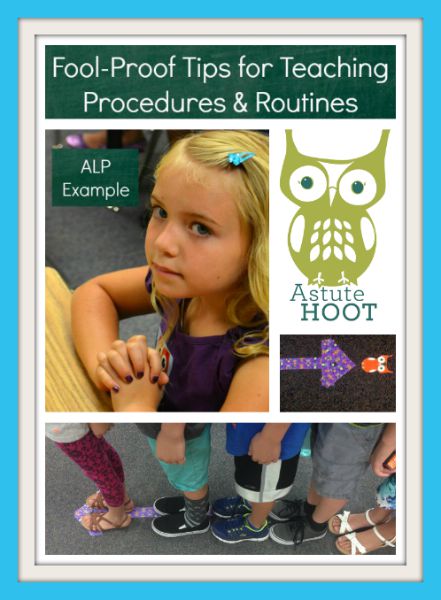
1. Teach Active Listening: Listening, like any other concept or skill, must be explained, modeled, practiced and reinforced, especially the first few weeks of school.  Students must know what listening looks like, sounds like and feels like. First, create a common definition of active listening. To do this, I give each student 3 colored Post-Its. On the first Post-It, I ask them to write down what active listening looks like. I call students up to the board and each student shares while I sort and label students’ responses. After all have shared, we come up with a consensus and repeat the process for the sounds like and feels like indicators. I record these on my Good Listening Poster. Next, we practice active listening indicators.  I share my Alert Listening Position (ALP) poem that teaches specific active listening behaviors and we practice these behaviors several times. Students are actively engaged in learning as they chant the second line of each stanza and model the listening behaviors with their bodies.  We also practice non-ALP behaviors such as slumping in seat, head on desk, no eye contact so students can understand non-examples.  While we are practicing, I rove the room and take pictures of excellent ALP examples and post to my ALP poem to use as visual reminders of expected behaviors. Students also get a copy of the ALP poem and add visual cues to help them remember active listening expectations.Teach active listening collage
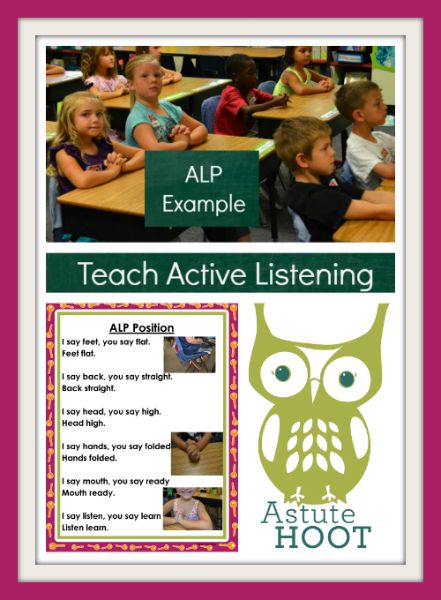
2. Perfect (Un)Packing Procedures: Unpacking and packing up can be a laborious, timely chore that can lead to a huge waste of instructional time. Students who have trouble staying focused often forget items or get lost during this time because they may struggle keeping track of this multi-step procedure. To teach this critical procedure, I select an unpacking/packing up song that I play every day the entire year. Students become familiar with the timing and lyrics and can use this to gauge how much time they have left to complete this procedure. I use Pharrell’s “Happy” as our unpacking song and it is a hit with the kids.I also create a visual checklist of all of the items needed to unpack and pack up. I use this visual checklist to model each specific step, one step at a time. I show the students how to do it and then start the music and let them do it. Have students freeze when done with that specific step. Then, refer to the visual checklist for the next. Be sure to set expectations for completion. Explain what students should do when they finish unpacking or packing up or else they will wander, talk, or dig in their desk. I tell my students to sit at their desks with an ALP and always praise those who unpack or pack up efficiently and redirect those who need a little extra help. Students will need a lot of modeling, practice, and reinforcement as they learn these new procedures. During the first week, I have students unpack and pack up with me, step by step. I gradually reduce the assistance, reviewing the visual checklist, and watching the students as they unpack/pack up. I stand in high traffic areas, reminding them to stay in a line or wait until person is done before putting water bottle away. I pick a couple of role models who demonstrate excellent unpacking skills and have these students model the specific behavior(s) to the class. By the end of the second week or start of the third week, students should be able to unpack/pack up independently using the visual checklist and music to assist as needed.Perfect Unpacking Procedures
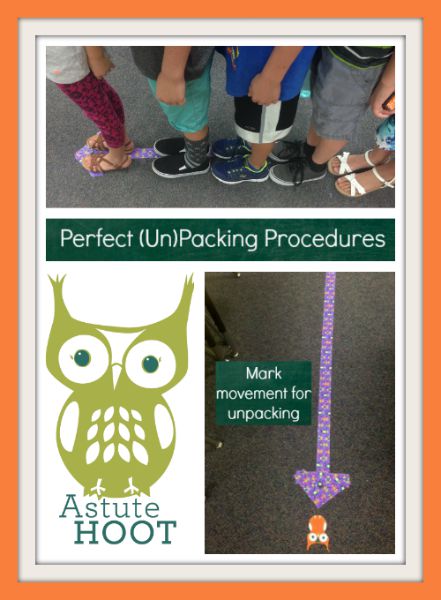
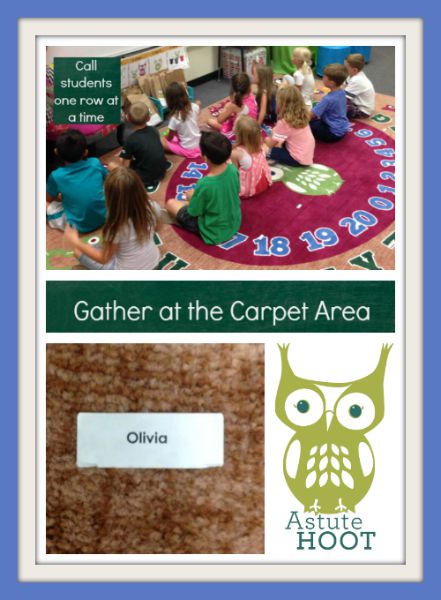
3. Gather at the Carpet Area: Assign each student a seat on the carpet area. I measure the space needed for each student and then add a self-adhesive label with child’s name on the carpet. Be sure to put students who have vision issues or behavior issues up front as a support. Model how to stand up, push in the chair, and walk quickly and quietly over to the carpet area. Name students in the first row in order, and have them walk over to the row and sit down in criss-cross position.  Repeat for the rest of the rows, giving praise for specific behaviors. Model returning to desks and then call rows one at a time back to desks. Practice this procedure several times over the first few weeks. When students are proficient with this, remove the labels. Gather at the carpet area collage
Are you overwhelmed with the thought of all of the routines, procedures and transitions you need to teach your students at the beginning of the year? Our Back to School Teacher Toolbox has everything you need to create an efficient classroom. This Toolbox contains engaging, colorful resources and activities that explain how to model, practice and reinforce important routines such as moving in the classroom, gathering materials, cleaning up, freezing at teacher’s signal, lining up, and tightening transitions.PREVIEW Routines and Procdures_Page_1
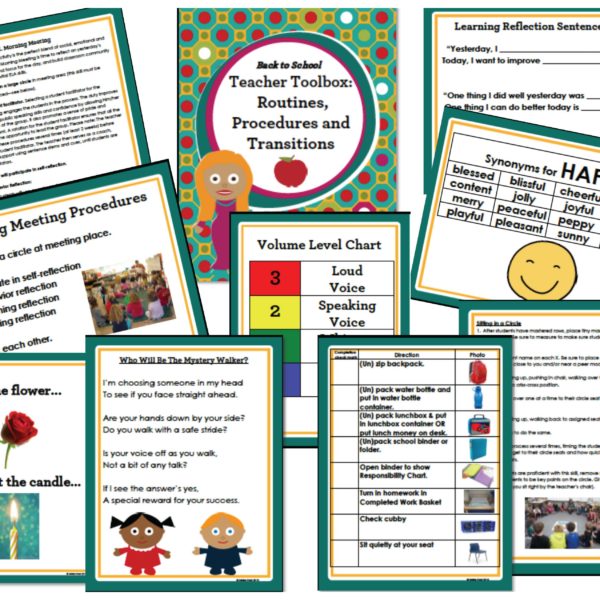
Work smarter, not harder with our ready-to-use back to school lessons and activities.  Happy New Year!

 

Jessica_blog_signature-SMALL


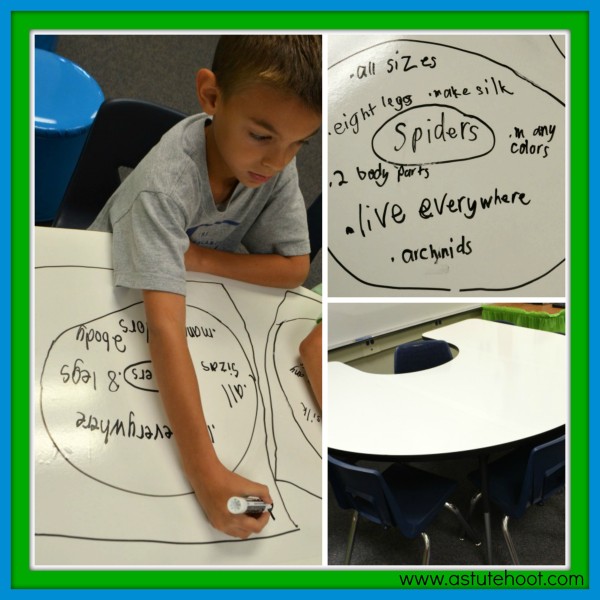
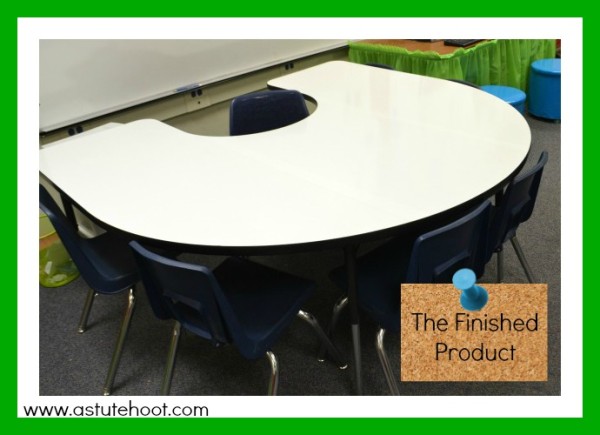
Use this dry erase table to promote active engagement during small group instruction.

Increase Student Engagement in 2 Easy Steps!

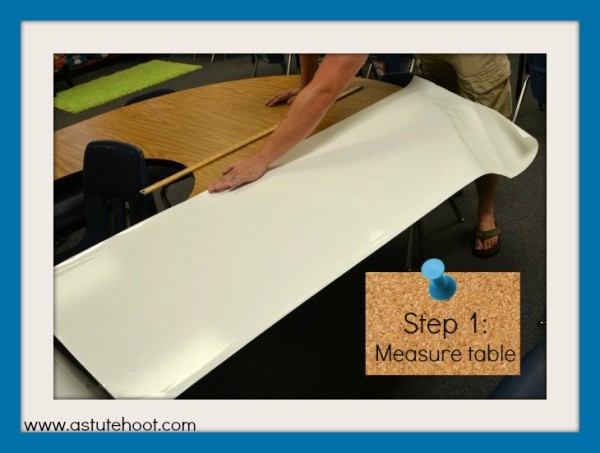
Create an amazing interactive whiteboard table for guided reading groups and math groups in two easy steps!  Purchase a roll of self-adhesive dry-erase paper.

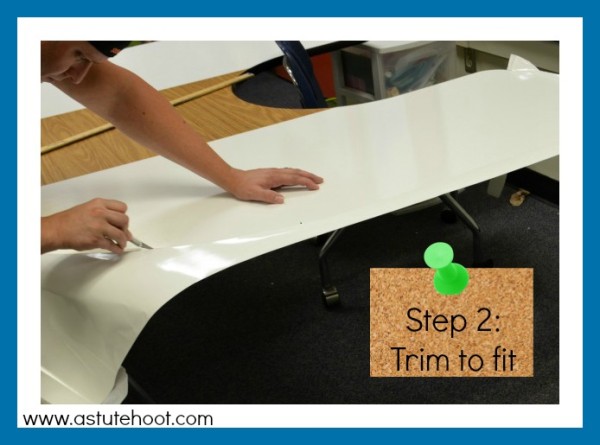
1. Measure Table.  Use a yardstick or measuring tape to determine dimensions of table. Roll out dry-erase paper and cut large sections to fit measurements. It is easier to do the sides first and then the middle.  Working in three smaller pieces will prevent bubbling and wrinkling.

Use this dry erase table to promote active engagement during small group instruction. 2.  Trim to Fit:  Use an Exacto knife to trim around the edges.  Colorful duct tape can be used to seal the edge of the table to prevent peeling.

Use this dry erase table to promote active engagement during small group instruction.

Use this dry erase table to promote active engagement during small group instruction.

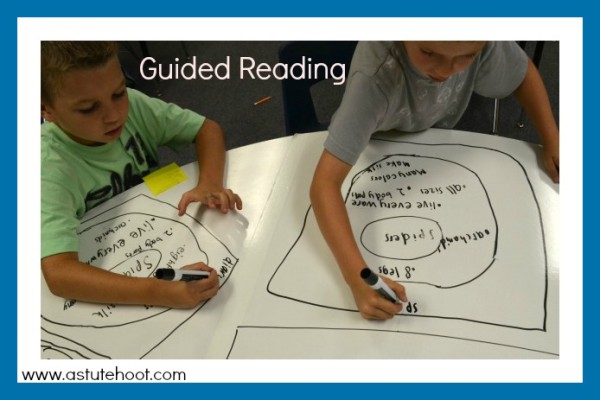
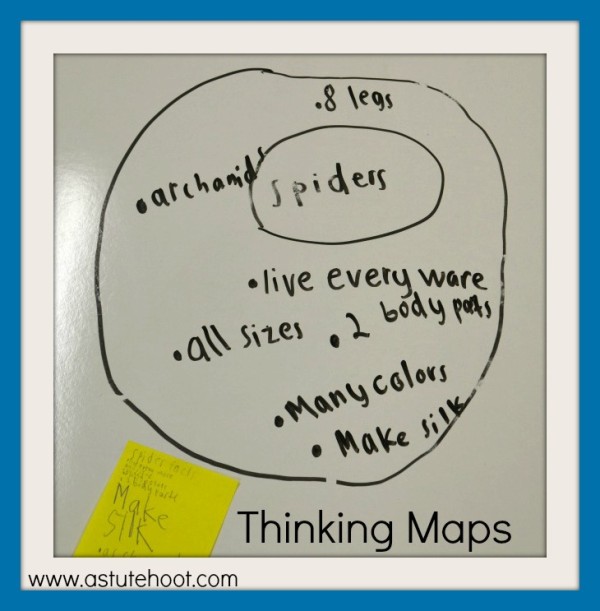
My students LOVE using this table to share their learning and engage throughout the lesson in a novel way.  In guided reading, we use the dry-erase table to create Thinking Maps, cite evidence, ask and answer questions, and note connections.  Students also write down key vocabulary words and illustrate the story elements.

Guided reading

Use this dry erase table to promote active engagement during small group instruction.

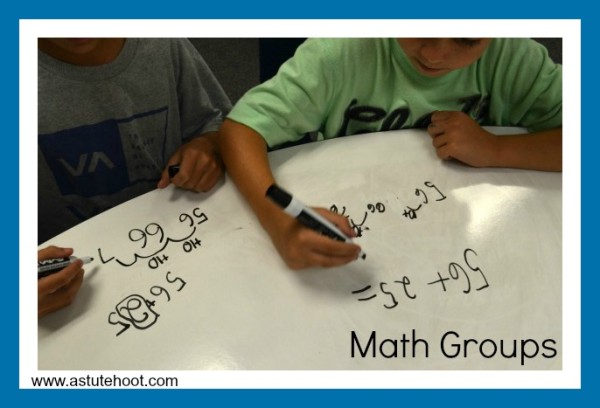
During math groups, we use the table to demonstrate thinking and solve problems.  Students draw mathematical pictures, tallies, number lines, and number sentences as they work through problems.  Students are encouraged to explain their work using their drawings.

Use this dry erase table to promote active engagement during small group instruction.

The whiteboard table can also be used as a behavioral incentive.  Stars or points can be awarded to each student in a little square or circle near their workspace on the table to encourage on-task behavior and work completion.

Jessica_blog_signature-SMALL

Set Up Your Best Classroom Yet: Part 3

Yesterday as part of my blog series, Set Up Your Best Classroom Yet, I gave you a sneak peek into my second grade classroom with a focus on my math area. I use the district prescribed curricula along with our reading, writing, and math strategy animals to help my students learn, apply, and transfer critical strategies across settings. My classroom décor centers around Hazel Hoot, an adorable green screech owl, and her special strategy friends. See how I integrate the Writing in the Wild West along with our hands-on tools to support and enhance the required writing curricula.

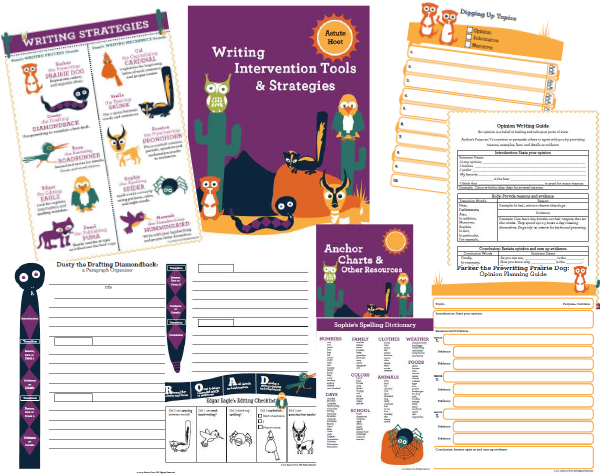
Writing Journal_cover

Special Spaces

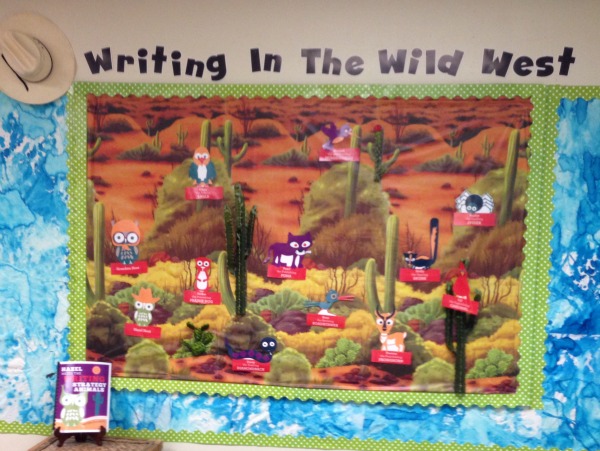
Writing in the Wild West

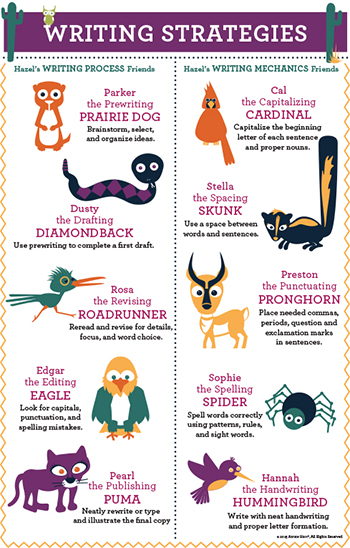
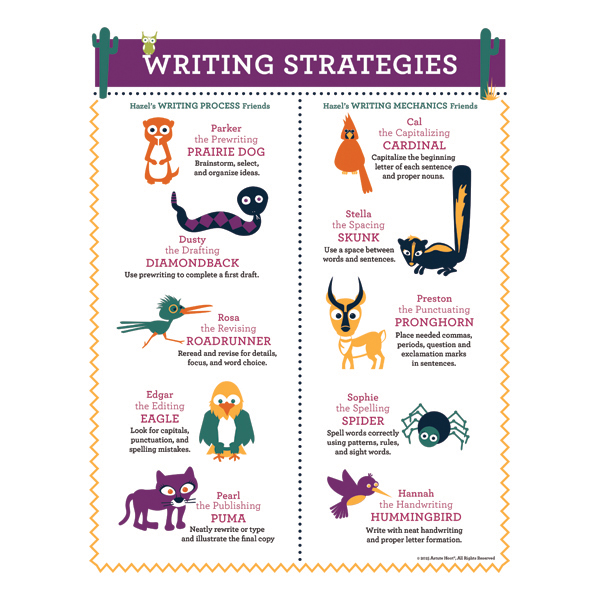
In our charming book, Hazel Meets the Writing Strategy Animals, students meet Hazel the owl, a struggling writer, who takes a vacation to the desert to visit Grandma Hoot.  Grandma suggests that Hazel take a hike for writing inspiration and along the way she meets 10 animals; 5 that teach the writing process and 5 that teach writing mechanics.

AstuteHoot_Writing_webposter

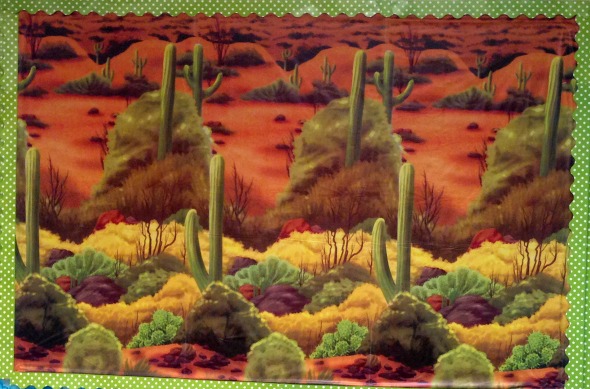
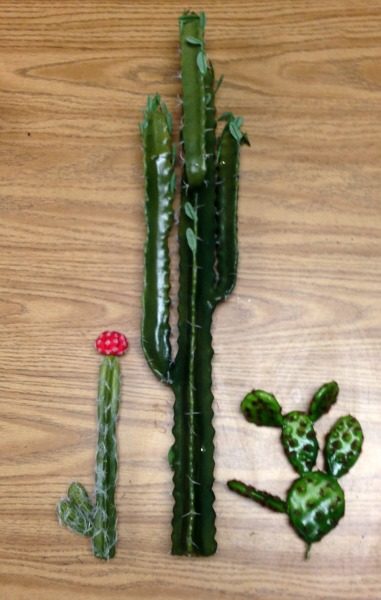
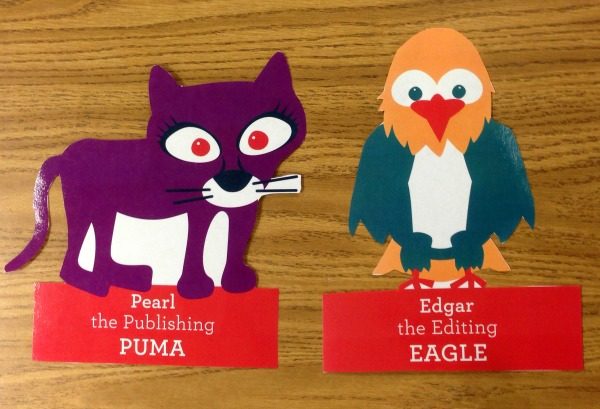
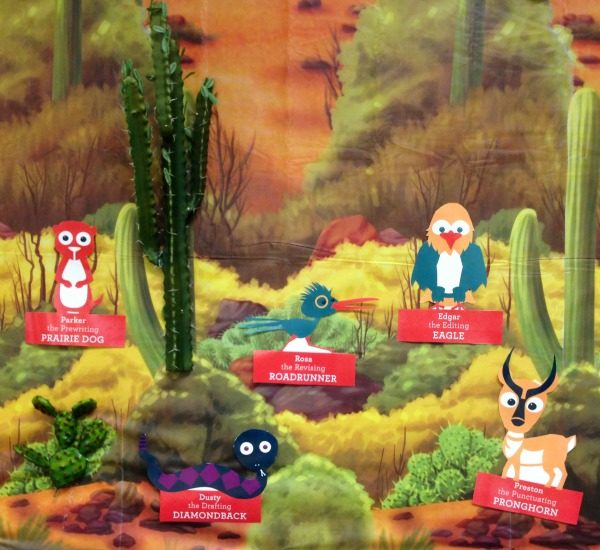
In order to recreate the desert scene for the Writing in the Wild West space, I covered a bulletin board with vinyl western background from Party City (similar items are available at most craft stores and on Amazon). I added faux cactus from Hobby Lobby to give it a 3D effect. I placed the Strategy Banners on the side of the bulletin board; I reference them throughout each lesson. I printed our Writing Bulletin Board Set added Velcro to the back of each strategy animal allowing me to detach to use during lessons.

Vinyl background.5Faux cactus .5Bulletin board 2

Wild West 5.5

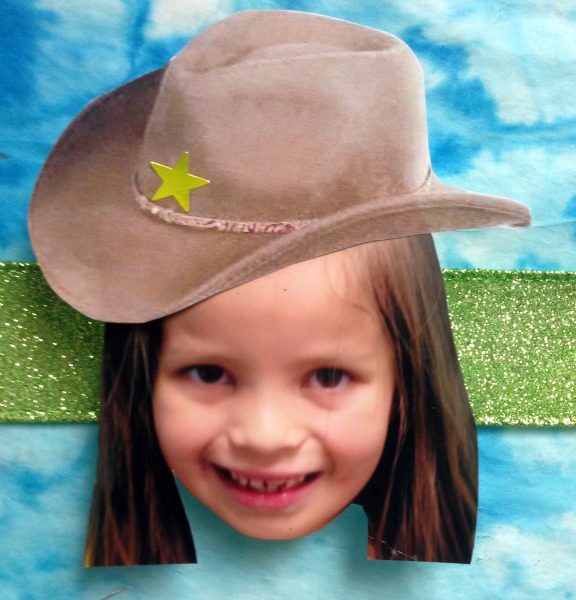
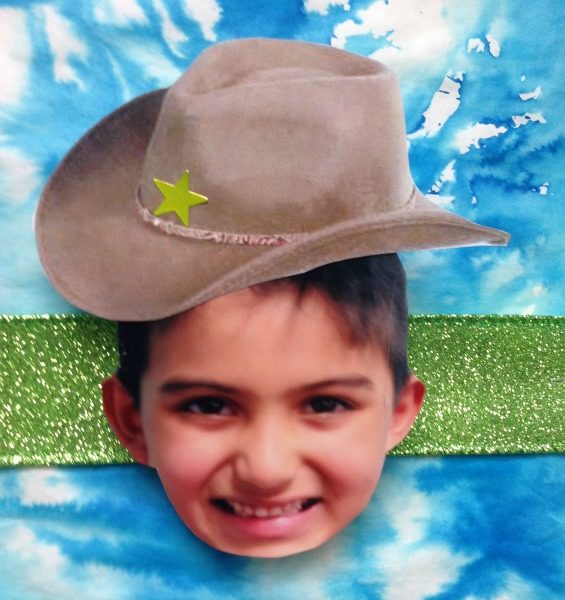
I also made a space to display student work. I took pictures of my students faces, printed and cut them out, and then added these adorable cowboy hats to each one. Finally I glued each picture onto a clothespin and glued the clothespins to thick ribbon that I stapled to the board. I use these cowboy clips to easily change writing samples frequently.

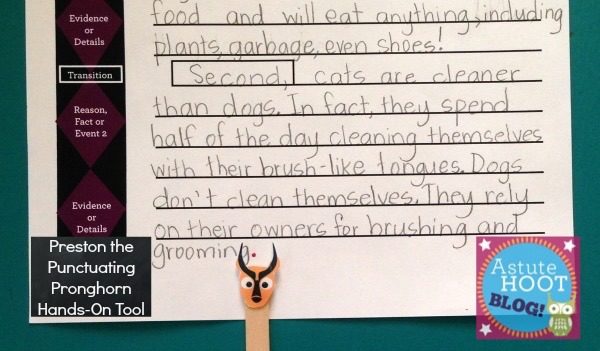
Cowboy hats 3.5Cowboy hats 2.5As the other blogs in this series mentioned, I love to display our hands-on tools in cute, inexpensive jars with printable animal labels.  Students have easy access to Stella’s Spacers, Cal’s Capitalizers, and Preston’s Punctuation Prongs, all which they enjoy using during writing time.
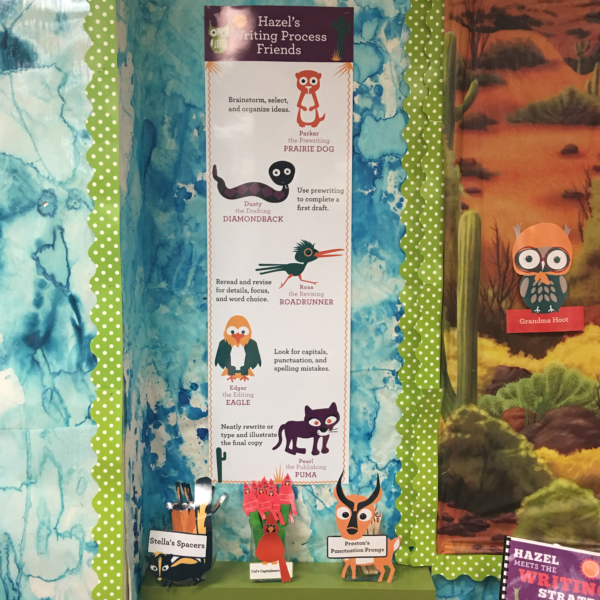
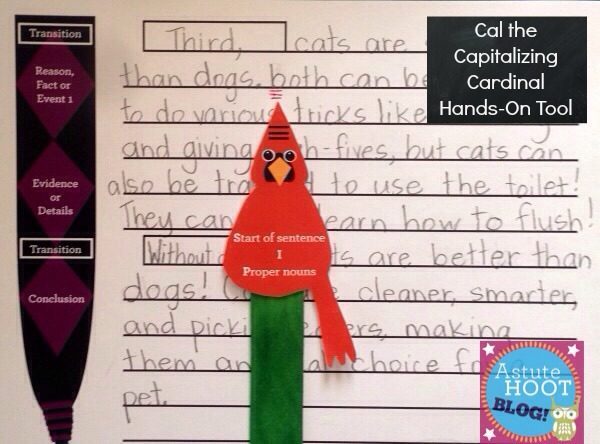
Banner and tools

Preston with blogCal the capitalizing cardinal with blogHave a cute classroom décor idea? I’d love to hear it! Be sure to check back on Sunday to read our latest Back to School blog.
Jessica_blog_signature-SMALL

Set Up Your Best Classroom Yet: Part 2

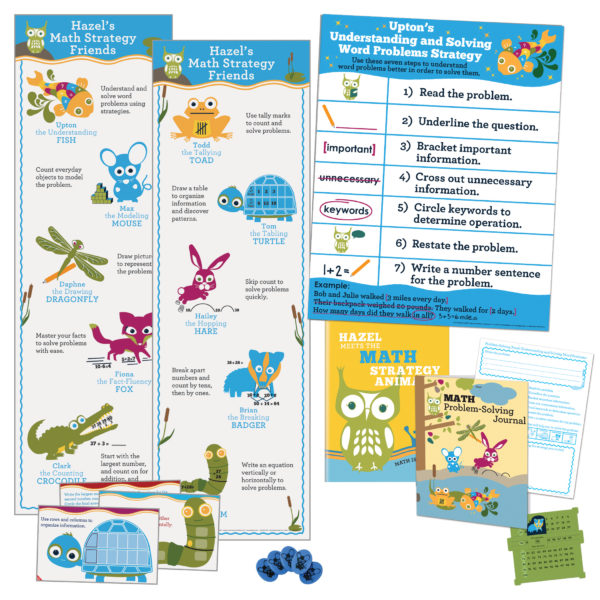
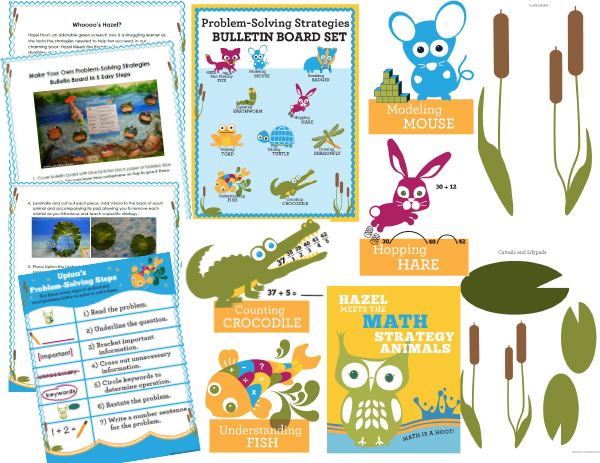
Yesterday as part of my blog series, Set Up Your Best Classroom Yet, I gave you a sneak peek into my second grade classroom with a focus on my guided reading area. I use the district prescribed curricula along with our reading, writing, and math strategy animals to help my students learn, apply, and transfer critical strategies across settings. My classroom décor centers around Hazel Hoot, an adorable green screech owl, and her special strategy friends. See how I integrate the Problem-Solving Pond along with our hands-on tools to support and enhance the required Saxon math curricula.

Astute Hoot Math Intervention Kit_RGB

Special Spaces

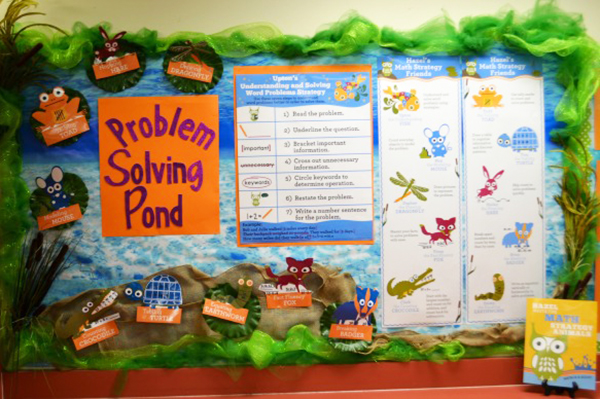
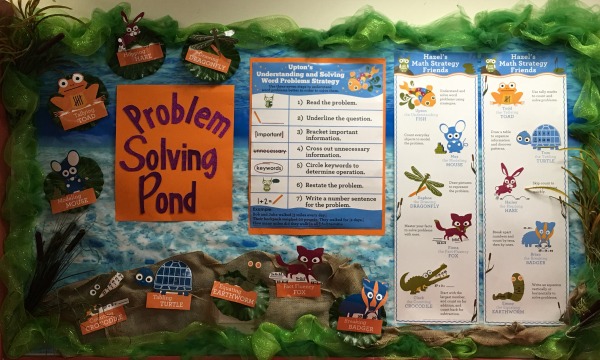
Problem Solving Pond

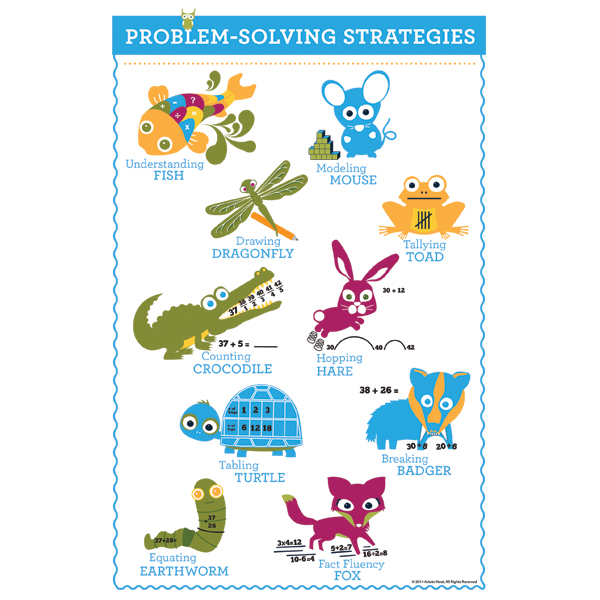
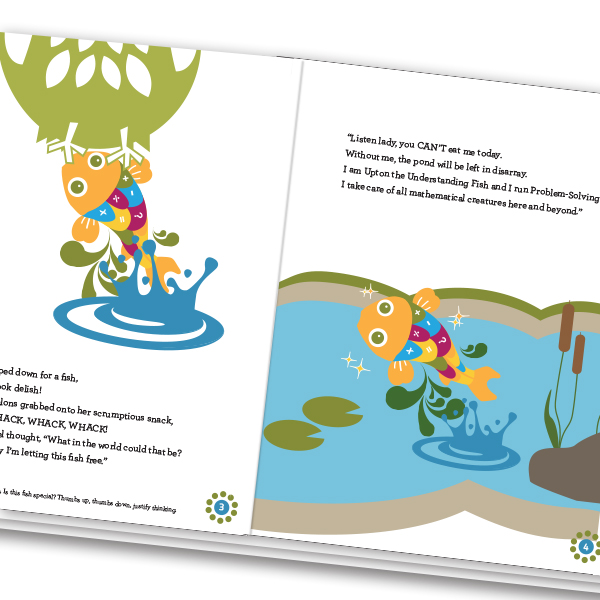
In our sequel, Hazel Meets the Math Strategy Friends, Hazel swoops down to catch her dinner at the local pond when she grabs Upton, an enchanted fish. Upton oversees Problem-Solving Pond and promises to introduce Hazel to his animal friends, all who teach a special problem-solving strategy. Using these strategies and Upton’s guidance, Hazel blossoms into an accomplished mathematician who is able to tackle problems with ease.

Math book_CU

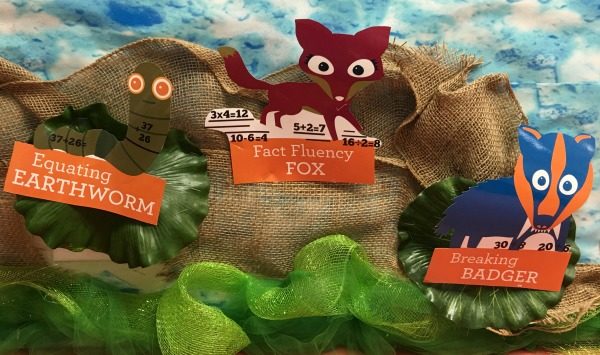
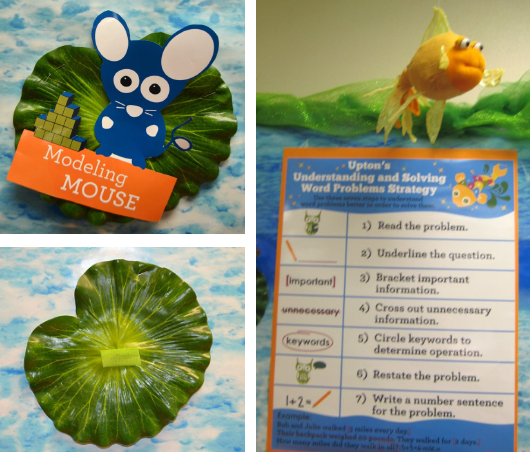
In order to recreate the Problem-Solving Pond, I covered a bulletin board with fadeless blue water paper and added green tulle and silk pond stems to border the pond. Upton’s Solving Word Problems Poster and Strategies Banners are prominent features of Problem-Solving Pond; I reference them throughout each lesson. I printed our Problem-Solving Pond Bulletin Board Set added Velcro to the back of each strategy animal allowing me to detach to use during lessons.

Bulletin board setpondI found this stuffed animal on Ebay that looks just like Upton and hung it with fishing wire and a plastic hook. During guided practice, I toss Upton to students and he helps us complete the problem-solving steps. Students LOVE solving problems with him!
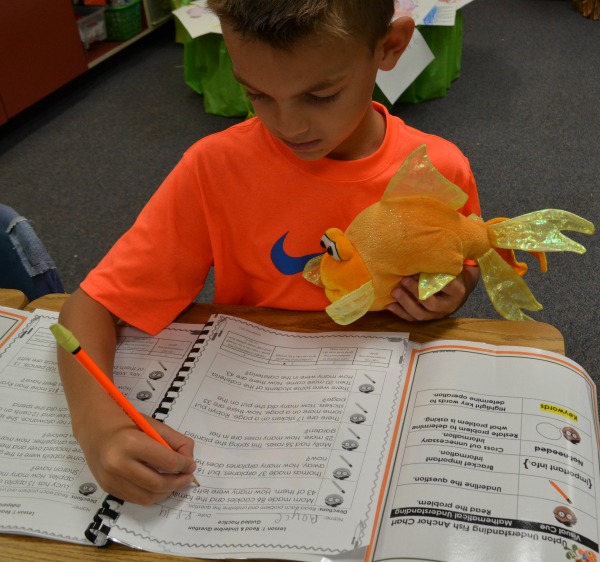
Problem-Solving Pond Upton with studentI also found inexpensive jars at Hobby Lobby to hold our hands-on tools such as Max’s Counters, Brian’s Slide and Learns, and Fiona’s Fact-Fluency Pencils and added these adorable labels.
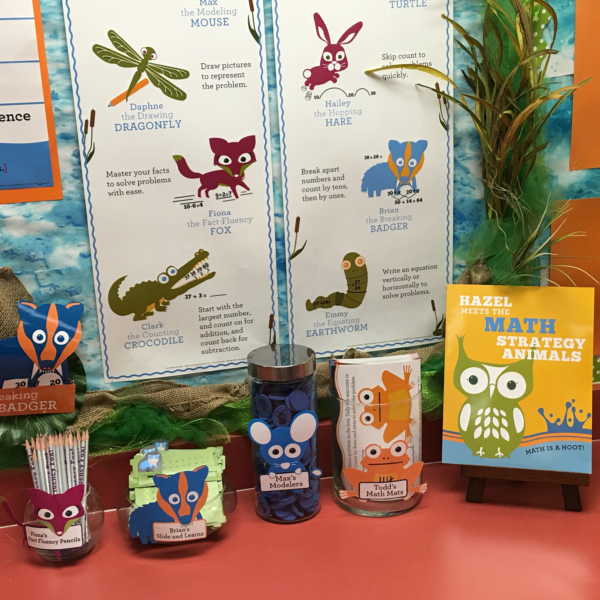
Hands-on toolsDuring center time, students solve their Saxon story problems using the strategy animals and our Problem-Solving Journals. They also use our hands-on tools such as Problem-Solving Mats, Brian’s Slide and Learns and Fiona’s Fact-Fluency Flashcards to reinforce learned strategies and concepts.
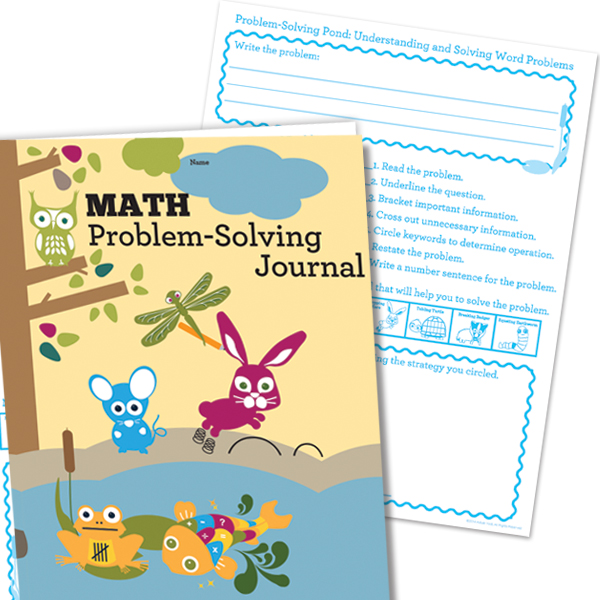
Math Journal_CUMath Mats_CU

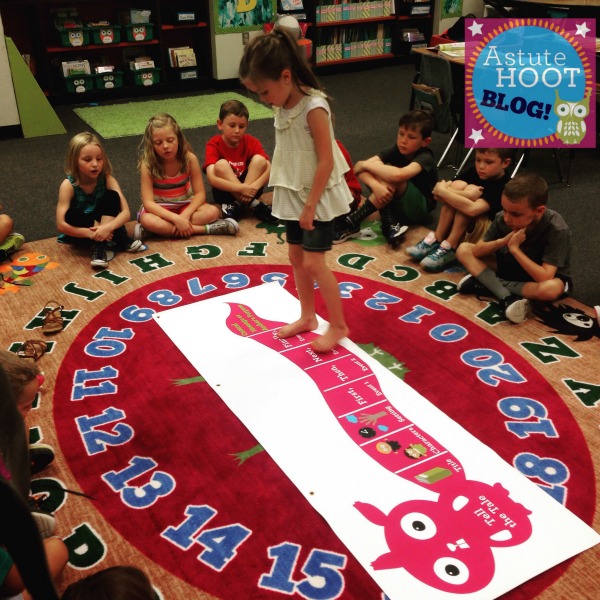
Students enjoy using the Astute Hoot rug to discuss their journal samples. They stand on the strategy animal that they used to solve the story problem and then discuss the strategies, process, and thinking they used.

breaking_badger_matRead tomorrow’s blog to see my Writing in the Wild West classroom space and accompanying hands-on tools.
Jessica_blog_signature-SMALL


The Attraction is Obvious!

We were very fortunate to receive some sample products from Dowling Magnets.  Our wheels are already turning and we’ve come up with some great uses for these resources in our classrooms in upcoming school year.

Kids LOVE the Make a Face Magnet Set pictured above. This 47 piece set is great for creative play, free time, and cooperative play.  I’ve been using this during summer tutoring as a break time choice between lesson activities.  I also plan to bring it along on our road trip to Utah and Colorado next week!

I’m super excited about the following magnetic math resources that I’ll get to use in the fall:

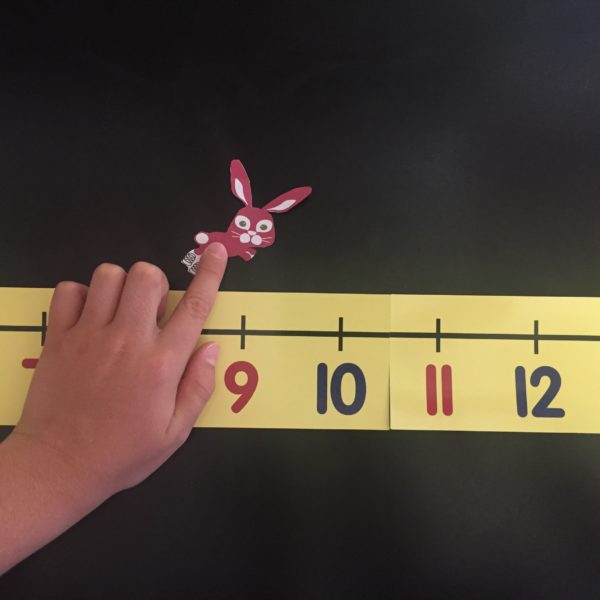
This Magnetic Demonstration Number Line will be a perfect fit for use with our math strategy animal Hailey the Hopping Hare.  Number lines are perfect for students to use place value, number sense and skip counting to add or subtract numbers. Students first start with the bigger number in the problem; this number is the starting point for hopping. Then they decompose or break apart the second number by place value (into 10’s and 1’s). Depending on the problem, students will either add or subtract, hopping first by 10’s and then by 1’s.  I plan to print out and laminate a small Hailey the Hopping Hare hands-on tool so students can use her to hop along the number line and keep their place.

FullSizeRender (7)

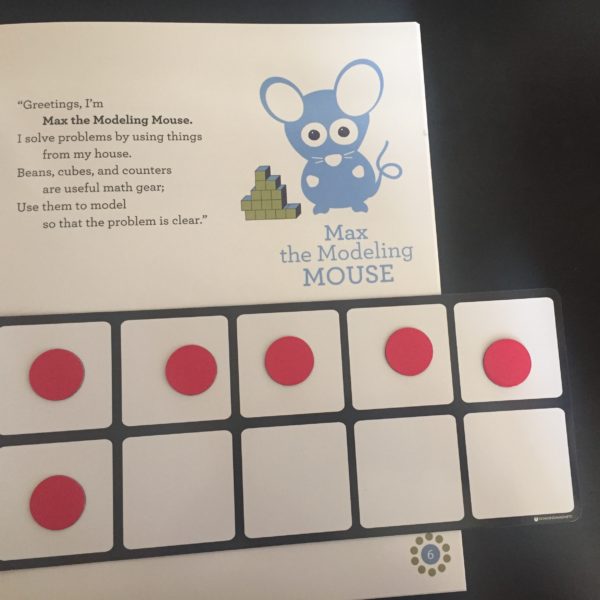
Using the Ten Frames Magnet Set will be perfect for students in my math intervention group to master counting, addition basic facts, place value, odd and even numbers within the context of ten.  What I like the most about these is the hands-on component.  The magnets are perfect for concrete learners and I love that they will stay in place rather than falling all over the desks and ground. Our math strategy animal Max the Modeling Mouse, will helping introduce this tool as he helps students use manipulatives, counters or drawings to model, or represent the mathematics of the story problem.

FullSizeRender (8)

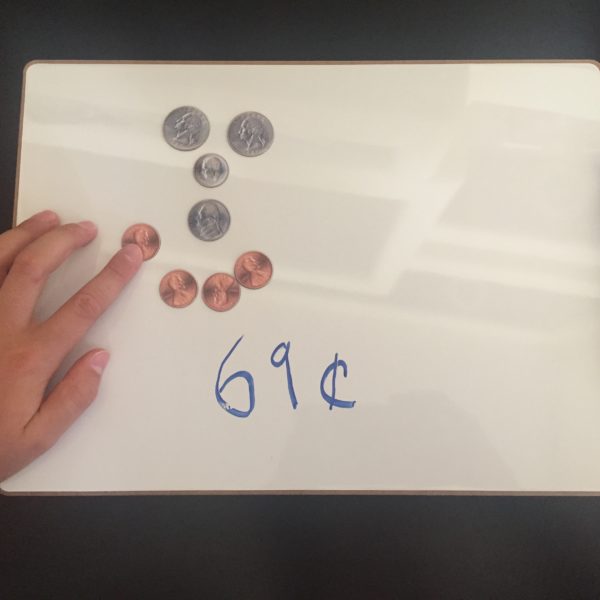
Another great resource is the Magnetic Coins. I anticipate that these will be very motivating for students to use along with the Magnetic Dry-Erase Boards.  Many students in the primary grades struggle to master money concepts.  I love using realistic coins rather than boring old worksheets to help students practice this critical life skill.

FullSizeRender (6)

For more information and other great magnetic resources, visit Dowling Magnets!

3 signatures_AH

Make Morning Meetings More Meaningful

The Morning Meeting should be the most meaningful 10 minutes of your day. Morning Meetings are at their best when they are the perfect blend of social, emotional, and academic activities. It is a time to reflect on yesterday’s success, set goals and focus for the day, and build classroom community all while practicing vital ELA skills. Despite the many benefits, the Morning Meeting is often the first item cut when teachers are crunched for time. Here are some tips to implement a meaningful Morning Meeting all year long:

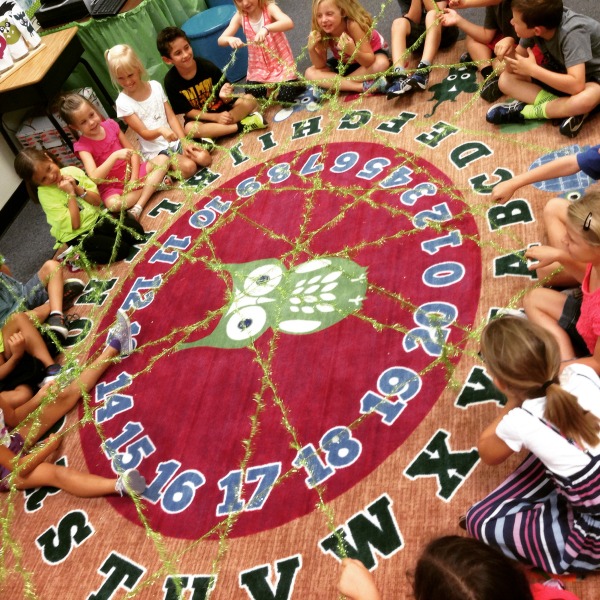
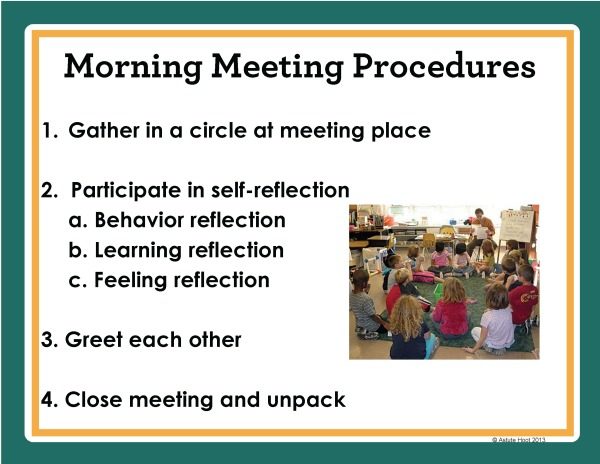
  1. Gather students in a large circle in your central meeting area. This is a skill that must be taught and practiced many times before students are expected to do it independently. Here are my students at Morning Meeting making a Friendship Web.
    Students sitting in circle
    Check out our Back to School Toolbox: Routines, Transitions, and Procedures unit for strategies to teach students how to gather at a meeting place.
  2. Select a student facilitator. Selecting a student facilitator in the Morning Meeting engages the students in the process and builds ownership. This duty improves each student’s public speaking skills and confidence by allowing him/her to take charge of the group. It also promotes a sense of pride and accomplishment. A rotation for the student facilitator ensures that all the students get the opportunity to lead the group.The teacher must model these procedures several times (at least 2 weeks) before selecting a student facilitator. The teacher then serves as a coach, scaffolding support using sentence stems and cues until students are adept facilitators.Morning Meeting procedures
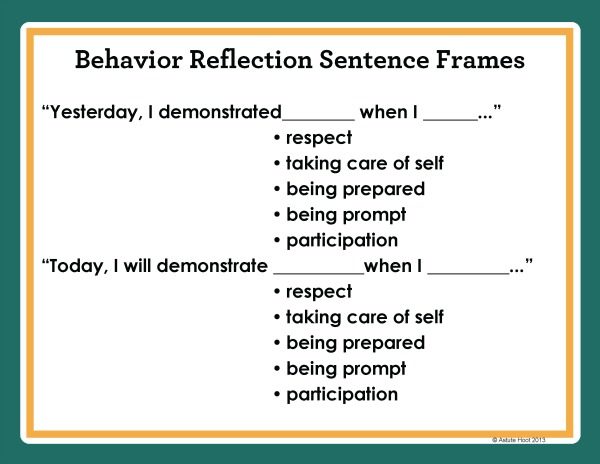
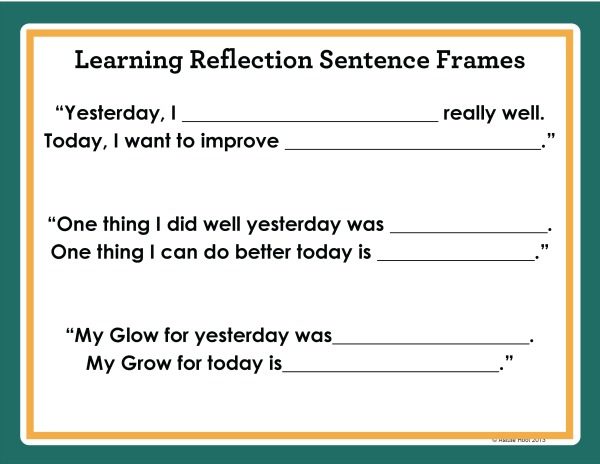
  3. Include behavioral and learning reflection. Use specific sentence stems to help students determine Glows (success) and Grows (areas of improvement). Behavior Self Reflection Sentence StemsLearning Self Reflection Sentence Stems
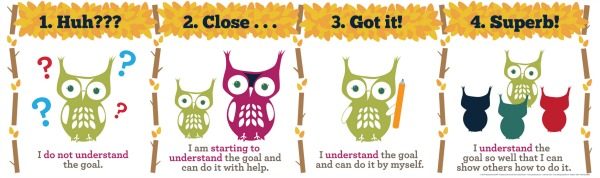
    Use a learning scale to help students rate and assess their progress towards a specific behavior or learning goal. Students can use a scale such as this and point to the corresponding box that represents their rating or use a finger cue to show their rating.Learning Scale_3 on pageFinger cues
  4. Greet each other. Teach students a variety of greetings or songs to promote classroom community. We love using Dr. Jean’s songs and chants for this purpose; they are ideal for K-3 students.
    Dr. Jean and friends
  5. Unpack and start your day. After students have set goals and a purpose for the day, they are ready to unpack and start their learning.Have a great Morning Meeting routine? We’d love to hear from you! Looking for additional strategies and tips to teach vital Back to School routines and procedures? Download our Back to School Toolbox: Routines, Procedures, and Transitions unit for tried-and-true suggestions from veteran teachers.Jessica_blog_signature-SMALL

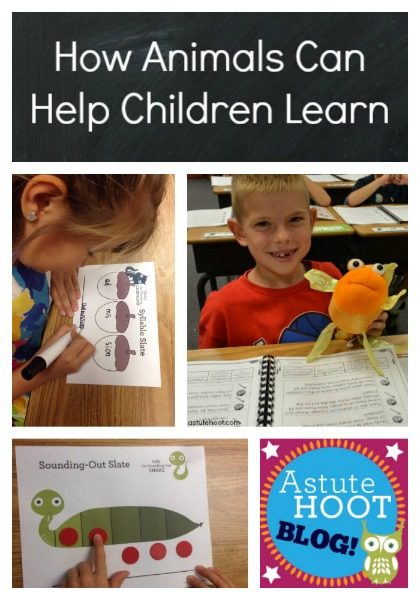
How Animals Can Help Children Learn

Animal characters are present in children’s lives from the very beginning on toys, books, and cartoons. Children soon learn to associate animals with comfort, play, and safety. When animals are personified, children readily understand and apply the lessons and messages from the animals. Our extensive research in animal assisted therapy along with our classroom experiences were the inspiration to creating our magical world of Astute Hoot filled with endearing animal characters to help children learn critical reading, writing and math characters.

At the start of each school year, I dress up as Hazel Hoot and read our introductory books to our students:  Hazel Meets the Reading Strategy Friends, Hazel Meets the Math Strategy Friends, Hazel Meets the Writing Strategy Friends. Students are instantly hooked and can’t wait to meet each strategy animal in upcoming lessons.  They get really into the read aloud and ask me questions about my roost and my animal friends such as “Who is your favorite animal friend?”, “How far did you fly from your roost?” and “Can you take letters from our class to the forest to give to the animals?”.

AH Slider_library_jenny

My students’ favorite activities are using  Sally Sounding-Out Snake and Charlie Chunking Chipmunk during our word study. Using these tools not only add much needed visual support, but also dramatically increase motivation and engagement. This is so important when using systematic phonics intervention programs as they can easily become monotonous.

How Animals Can Help Children Learn Collage

Just recently I was doing a fact assessment. I always remind students to double-check their answers, but they rarely do. I got out my Fiona Fact Fluency Fox puppet and had Fiona remind the kids about double-checking and what do you know, they all double-checked their answers. They listen to Fiona’s reminders more readily than mine!

As you can see, our strategy animals anchor the classroom. Our students LOVE meeting each new character and consistently use their strategies in whole group, small group and even independent work!  Many parents even report learning about the strategy animals from their children at home too!

Hazel's Reading Roost_rs

Problem-Solving Pond_rs

Meet all of our strategy animals here!  Bring the magical world of Astute Hoot to your classroom too by downloading our comprehensive strategy units from our TPT store or directly from our website: Reading, Math, Writing.
Reading Strategies Poster_web

Math Strategies Poster_web

Writing Strategies Poster_web

Download these strategy posters here. See how our very own students interact with our strategy animals in this cute video!

As you can see, our animals are a hit with our students!  Do you use animals in your classroom?  We’d love to hear about it!  Please comment below.

Josh Testimonial

To learn more about animal assisted therapy, check out these links:
Animals Helping Children with Special Needs
Pets in the Classroom
Reading to Dogs Helps Children Learn to Read

3 signatures_AH


End of the Year Survival Guide


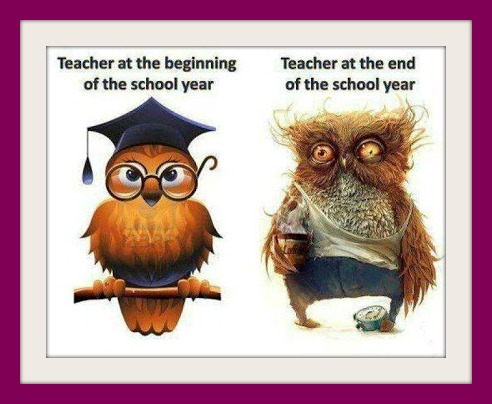
Let’s face it, at this time of year, we all feel like the owl on the right. Keeping students engaged at the end of the year is like running a three-ring circus, leaving teachers tired and exasperated. Use these 8 tips to survive (and enjoy) the end of year countdown:

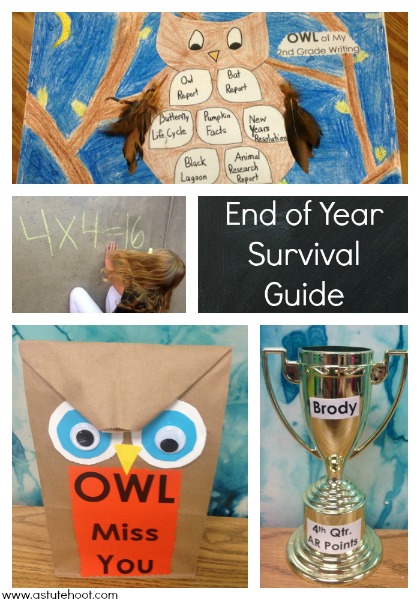
End of year collage

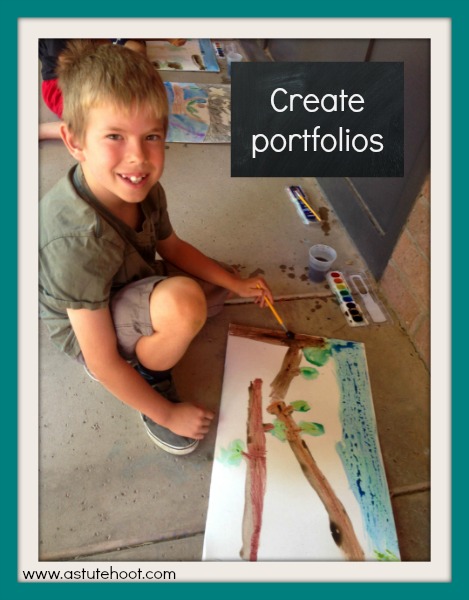
1. Create portfolios: Showcase students’ finest work samples with student-made portfolios. Make durable portfolios by folding pieces of poster board and stapling along the sides. Students can draw a detailed picture with crayon and then add water color to make a beautiful crayon resist effect. While the class is working, help students individually determine which pieces to include in their portfolios. Be sure to include rubrics and learning scales that accompany each piece.

Creating portfolios

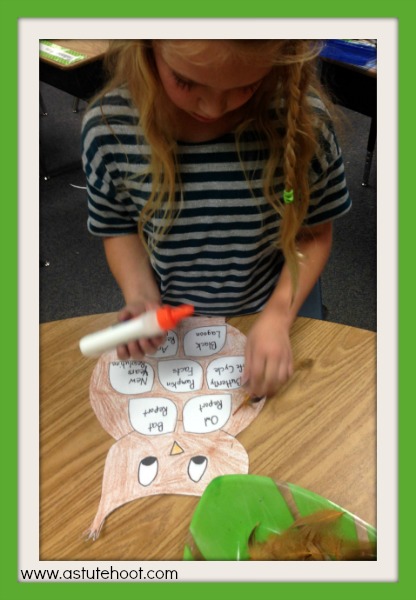
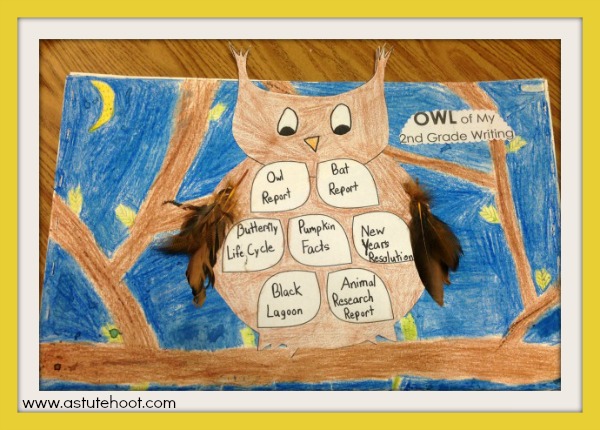
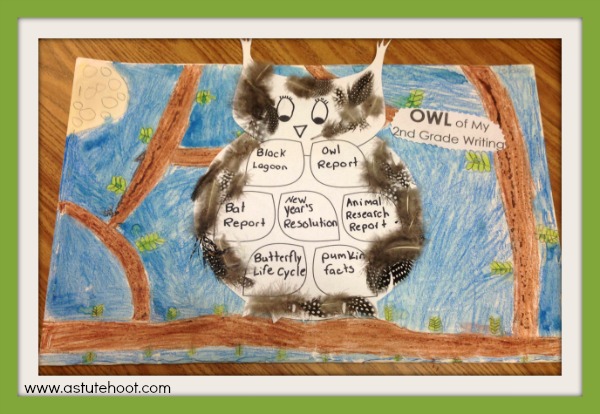
My students used this owl template as a table of contents for portfolio contents. They colored and added craft feathers to owl and glued onto the dried portfolio after completion.

Owl portfolios

Portfolio 3

Portfolio 2

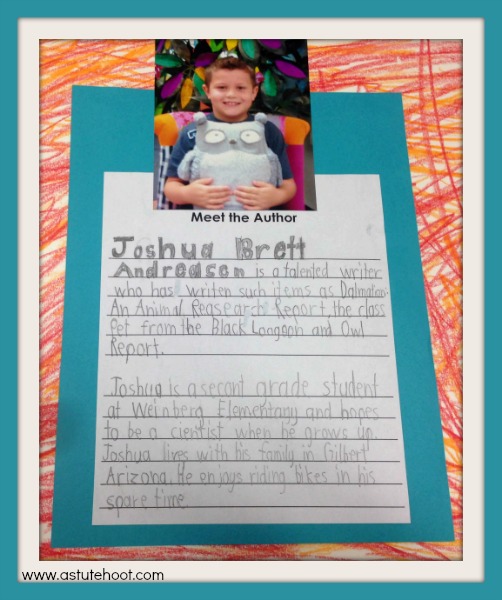
Students wrote Author’s Notes on the back of portfolios that provide a short biography and current picture. We studied several examples from our favorite authors first. Students were so proud to have their very own version just like many authors they studied throughout the year.

Meet the Author notes

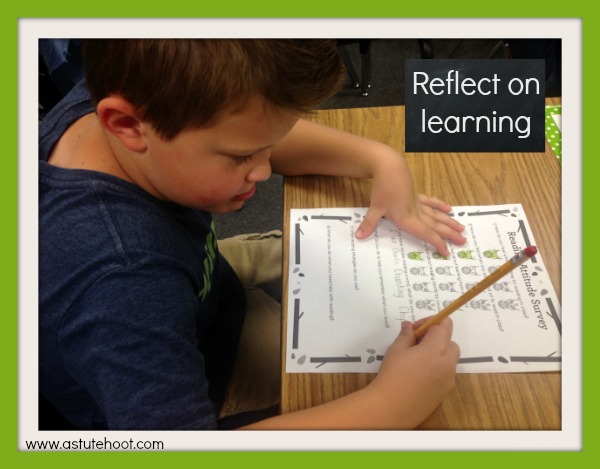
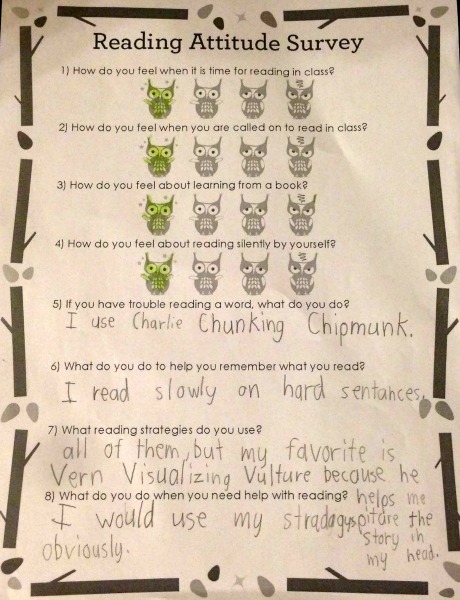
2. Reflect on learning: In the beginning of the year, my students completed reading and math attitude surveys, giving me vital information about their background knowledge, strategy application, and confidence level. I was surprised at how many lacked strategies and self-help skills. I gave the same surveys at the end of the year and the growth was tremendous. Students could easily explain strategies they used and all were very confident. I included a picture of one of my favorites. When asked what students do when they need help with reading, the student responded, “I use my strategies, obviously!”.

Students can also track their own assessment data on bar graphs, creating a meaningful visual of growth throughout the year. My students graph their DIBELS fluency scores, monthly Morrison McCall Spalding spelling tests, and Saxon fact assessment scores. Tracking growth helps students take ownership in their learning and is a great way to celebrate success.

Reflection 1

Reflection 2

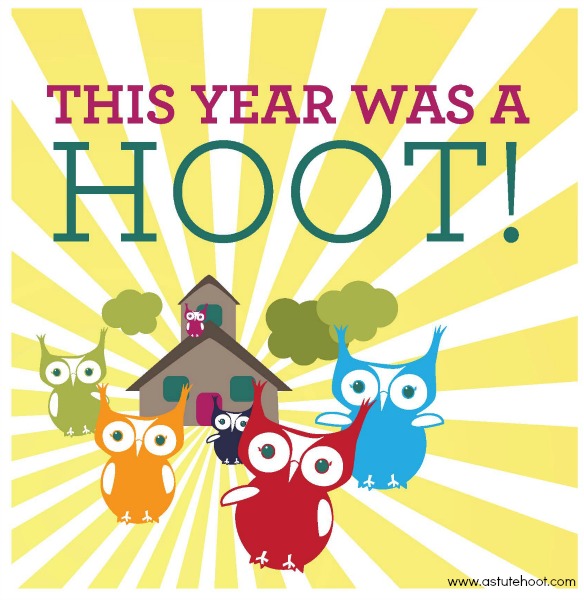
3. Create end of year journals: Use This Year Was A Hoot! to reflect and record key highlights from the year. This customizable journal includes A Note From The Wise Old Owl (write a special note to your class), OWL-Stars (place for class photos), Branching Out (students record what they learned, became, who they met and how they felt), HOO-Ray! (students write top 10 events of the school year) and much more. My students loved OWL of these activities! Parents enjoy seeing the end of school year journals too.

Pages from ThisYearWasAHootEndofSchoolYearJournal

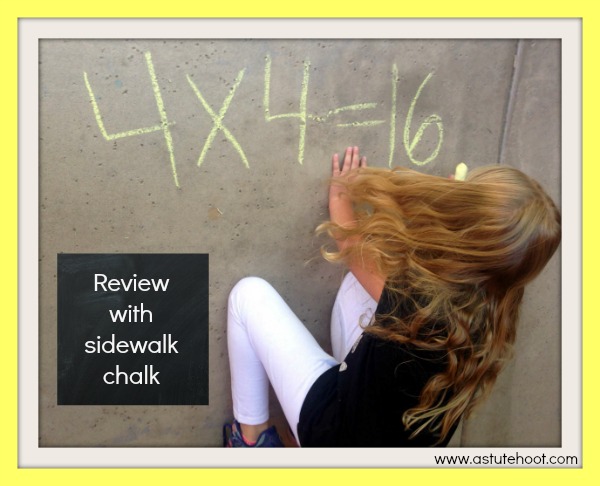
4. Review with sidewalk chalk: Review and practice important concepts using sidewalk chalk. Give students a story problem to solve or a reading response question and allow them to use sidewalk chalk to complete it. Chalk is perfect for spelling and fact practice as well. Plus, it washes off easily with soap and water.

Sidewalk chalk

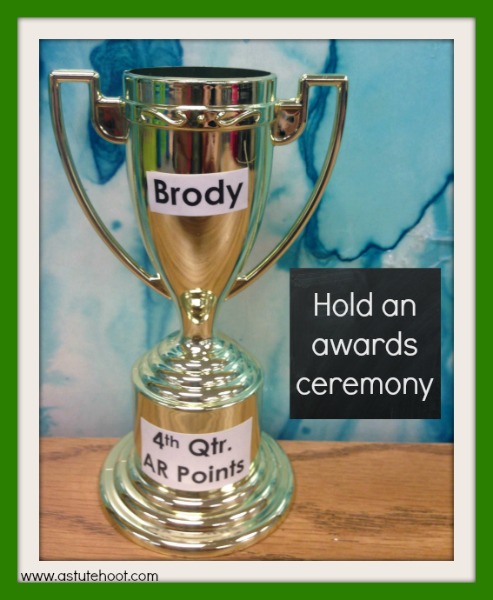
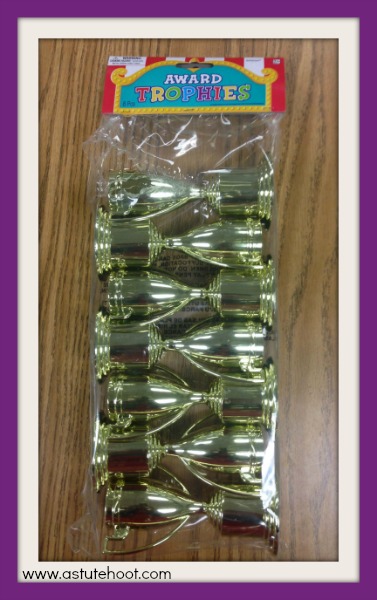
5. Hold an awards ceremony: Celebrate accomplishments with a classroom awards ceremony. I purchased these inexpensive plastic trophies from Party City and used address labels to make these customized awards. I award trophies for top reader, most improved reader, good citizenship, perfect attendance and much more. Students LOVE them and some actually think they are real gold.

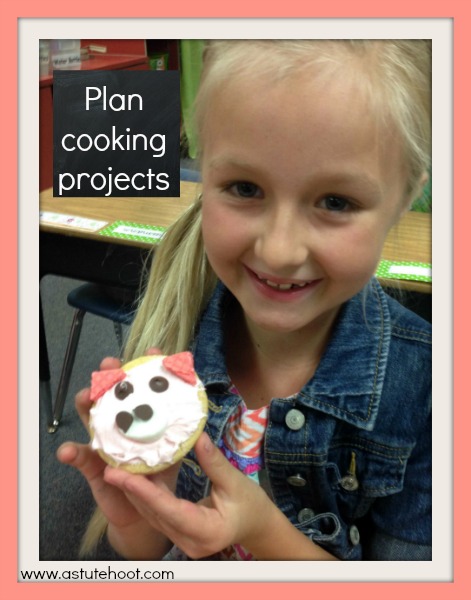
TrophiesParty City Trophies6. Plan cooking projects: Find recipes for a theme-based snack or a craft project to use as a culminating activity. Students love these and they provide an opportunity to read functional text. We just finished Charlotte’s Web so my students read a recipe to create these cute pig cupcakes.
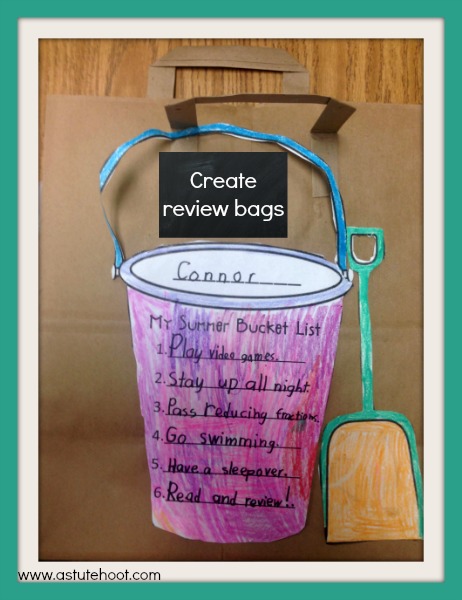
Cooking projects7. Make review bags: Create review bags that include worksheets, games, and text at students’ instructional levels. Encourage students to read and review for at least 30 minutes daily. During the first week of school, I provide a reunion breakfast for students who completed the summer review bag. This is a great incentive to review throughout the summer, plus it provides a wonderful opportunity to catch up with former students. I use a Bashas’ brown bag to hold materials because the sturdy handles allow for easy transportation.
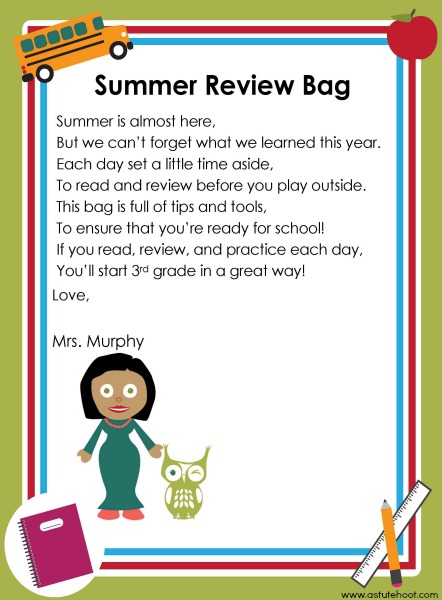
Summer review bagsSummer review bag

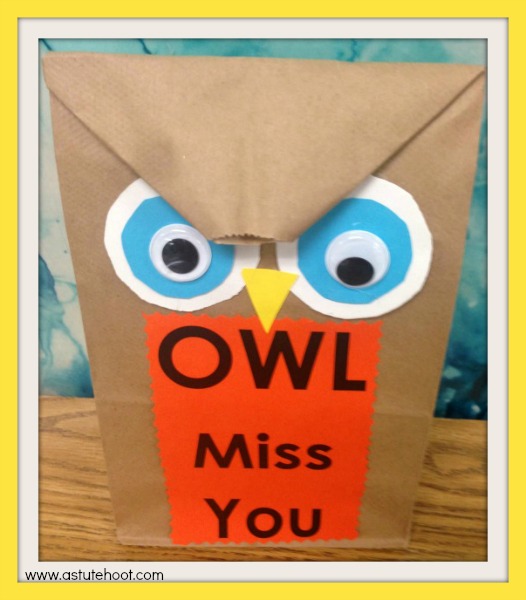
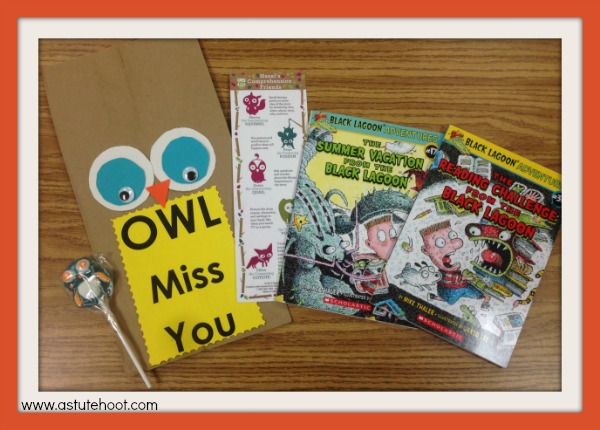
8. Provide an end of the year gift: Books make the best gifts and there are always great deals through book orders. This year I made these adorable owl gift bags and added our decoding and comprehension bookmark from Really Good Stuff and an owl lollipop. I can’t wait for them to open them!

OWL Treat BagOwl treat bag materials

Have a great end of the year survival tip? Please share below. Enjoy your last few days with students–we can make it!

Jessica_blog_signature-SMALL

You Deserve a Discount!

By popular demand, we’ve bundled all of our strategy resources into 2 different Site License options to give you the best possible deal! The Astute Hoot Reading Site License contains over 20 complete decoding and comprehension units and the Astute Hoot Math Site License contains 12 complete problem-solving strategy units. Both options include THOUSANDS of pages the following components:

• Suggestions for use

• Detailed lesson plans using the gradual release of responsibility method

• Built-in assessments and learning scales

• Graphic organizers and reproducibles

• Anchor charts and posters

• Templates for hands-on tools

• I Can statements

• Game boards

• Flash cards

• Customizable problem-solving or reading comprehension journals

• Discussion prompts

• Hazel Meets the Strategy Animals book

• Bulletin Board Set

• And much more!

Using these resources and tools, the most reluctant students blossom into motivated, enthusiastic learners; make solid connections to the strategies, and most importantly, become proficient readers and mathematicians. Used in classrooms around the world, these innovative tools awaken the joy of learning and spark enthusiasm in all students while providing research and standards based resources for students in grades K-3.

Get an early start on Back to School season by downloading the Site License options from our website or from our store on TeachersPayTeachers. Each Site License download includes so many great files and resources that the zip file you will be downloading is close to 300MB. Thank you!

Jessica_blog_signature-SMALL

Guiding Students to Use Context Clues Independently

“Hello, Ramona the Rereading Raccoon is my name.
Using context clues is my favorite game.
As you read, ask yourself:
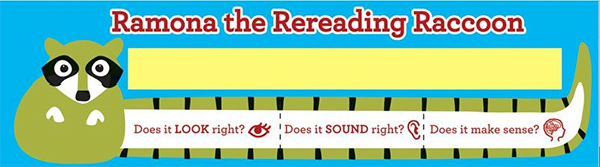
Does it look right, does it sound right, and does it make sense?
I guarantee my strategy will make you less tense!”

ramona
Ramona the Rereading Raccoon
is one our decoding strategy animals in Hazel’s Reading Roost. Ramona motivates students to use context clues independently. Read more about Ramona’s strategy below…

WHAT is rereading? Rereading along with using context clues can be used a word identification strategy. The context is the words, sentences, and ideas that come before and after a word or phrase. Context clues are words or phrases that hint at what the unknown word means. This helps readers build meaning to increase comprehension.

WHY is rereading important? Rereading using context clues is an essential decoding strategy that promotes independence in beginning readers. It also builds vocabulary, strengthens comprehension and can be used to build fluency.

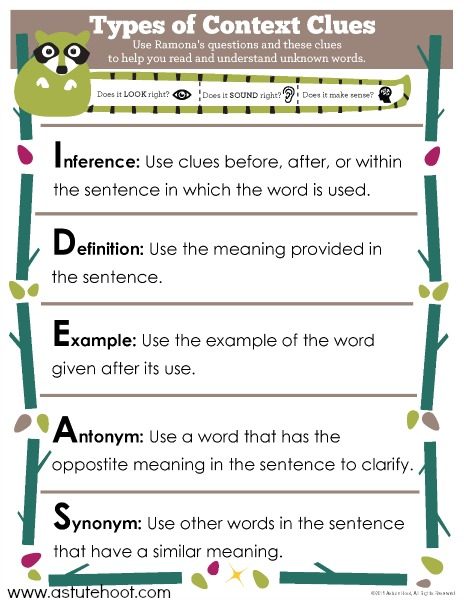
HOW do I teach rereading? Explain that Ramona helps readers use clues from words and sentences surrounding an unknown word in order to decode it and make meaning. Provide explicit instruction in recognizing context clues and using them while reading authentic text. Incorporate think-alouds that focus on using each specific type of clue to decode and determine meaning (e.g., synonym, antonym, example, definition, inference). Model rereading the sentence and answering Ramona’s question prompts to determine if a word or meaning is correct.

Watch this video to see how to teach context clues in three easy steps:

WHEN should I use rereading? Explicit reading strategy instruction should be included in a balanced literacy program. Ramona the Rereading Raccoon can be incorporated into various components of literacy lessons. Here are some specific examples of when to use Ramona:

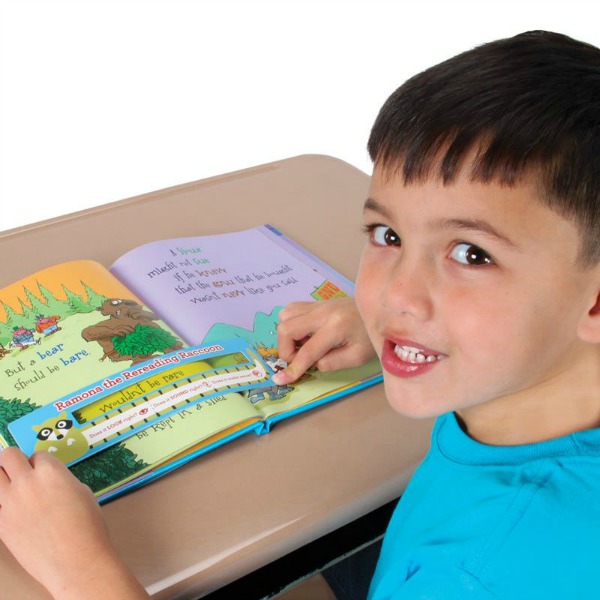
  • Ramona’s Re-Readers: Divide students into pairs or work in a small reading group and distribute Ramona’s Re-Readers to each pair or student in the small group, keeping one to use. Read Ramona the Rereading Raccoon Poem to introduce the strategy of using context clues to decode words and make meaning. Select targeted unfamiliar words from text to model using Ramona’s Re-Readers by placing her “tail” beneath the sentence with the unknown word. Demonstrate reading around the word (i.e., read text before and after the word). Make a prediction about what the word could be or its possible meaning. Reread the entire sentence using the predicted word and ask the following questions to confirm accuracy, “Does it look right? Does it sound right? Does it make sense?”. Explain that if the answer is “yes” to all three questions, then the word is correct.
Ramona Rereader RGS website
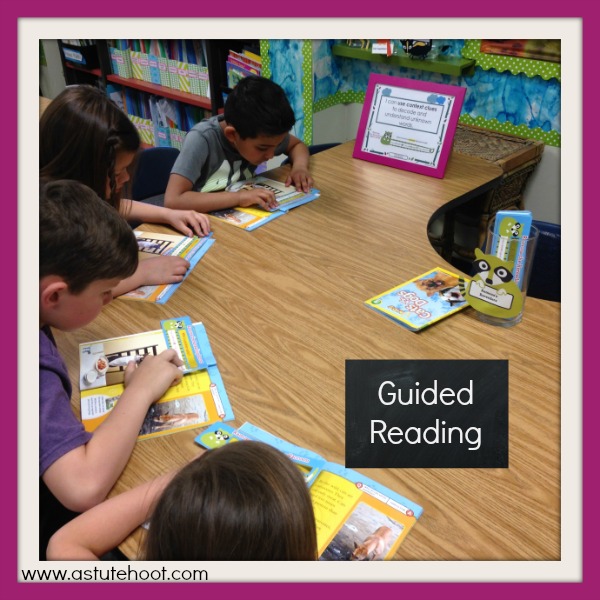
  • Guided Reading: Review the strategy by reading the Ramona Rereading Raccoon Poem. Read aloud your selected guided reading text and model using Ramona’s Re-Readers. Distribute text and Ramona’s Re-Readers to each student. Call on individual students to use the Ramona’s Re-Readers as they read aloud if they get stuck on decoding a word or are unsure of a meaning. Prompt students to use the questions listed on the Ramona’s Re-Readers as they reread to self-assess and monitor understanding. Discuss the context clues students used to help them determine unfamiliar words and meanings. Encourage students to use Ramona the Rereading Raccoon’s strategy when they are reading independently as well.
Guided reading
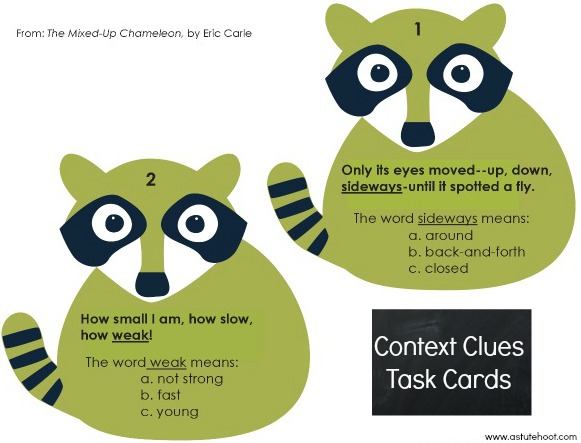
  • Ramona’s Task Cards: For additional context clue practice, use Ramona’s Context Clue Task Cards during partner or independent work.  Students read sentences selected from authentic literature and use Ramona’s strategy to decode and make meaning of the underlined word.
    Ramona task card sample
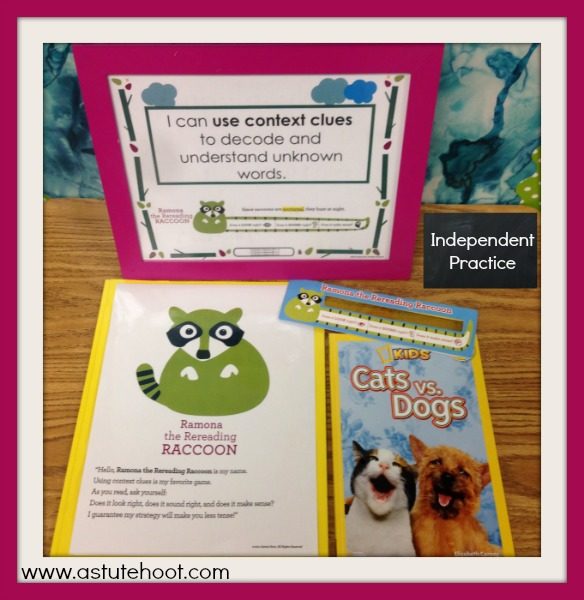
  • Rereading Raccoon Center: Create a portable reading center: Place a Ramona’s Re-Reader and a book or text at students’ reading level in a large manila envelope with a copy of the Ramona Rereading Raccoon Poem glued onto the front. Instruct students that during center time they are to take an envelope to their desks and use the Ramona’s Re-Reader to use context clues and self-assess understanding while reading. Create several portable Rereading Raccoon centers using a variety of leveled texts.
  • Independent Practice: Have Ramona’s Re-Readers available for student use during independent reading time. This promotes transfer of reading strategies and self-correction techniques while helping students stay focused on the text.
Ramona center

Helpful hints:

  • Create a class set of Ramona’s Re-Readers. Print Ramona’s Re-Readers onto cardstock and laminate. Distribute to class and model how to use during reading. These can help keep students actively engaged during choral reading, independent reading and small group. Sturdy, pre-made Re-Readers can be purchased from Really Good Stuff here.
  • Display an anchor chart of types of context clues. Print and post Types of Context Clues located in this folder or create your own anchor chart that includes the various types of context clues along with examples and visual cues. Display near your guided reading center for easy reference during reading time.
Context clues poster

Ramona’s unit is perfect for general education, special education, RTI and reading intervention.  Download the complete unit here.

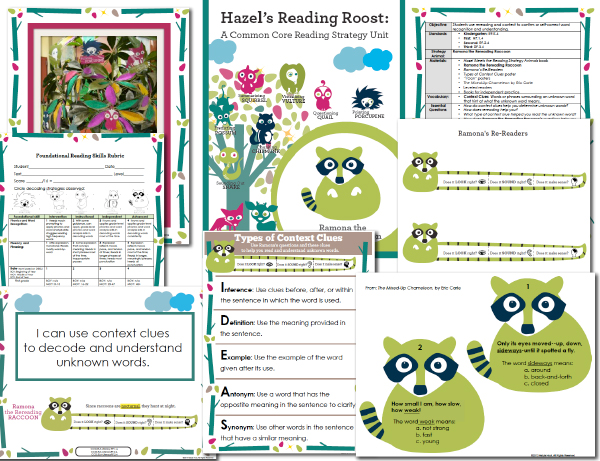
Microsoft Word - 0.Preview.Ramona Rereading Raccoon.docJessica_blog_signature-SMALL

Teach Central Message & Theme with Dr. Seuss

Students love Dr. Seuss books because of their engaging, rhymed text, memorable characters, and whimsical illustrations. But, Dr. Seuss books are so much more. They are the ideal tool for teaching central message because each one focuses on a specific theme or life lesson. Plus, the majority of students have had multiple exposures with these books; they are familiar with characters and sequence of events. This background knowledge and literal level of understanding makes it easier to determine the central message, a higher-level comprehension skill.

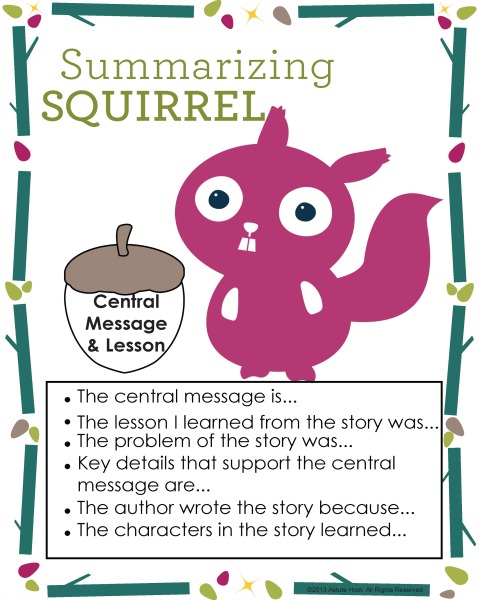
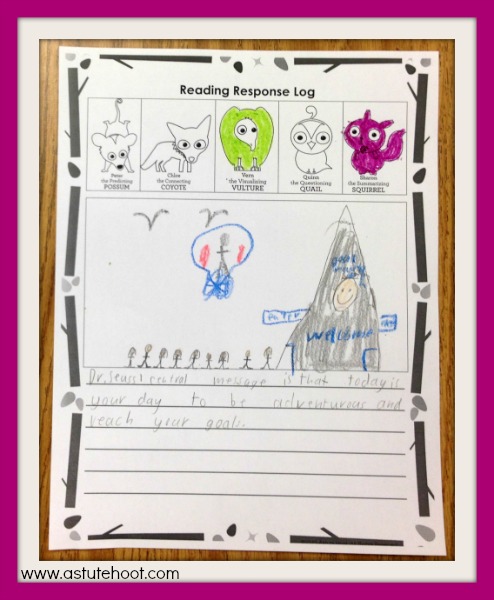
During our Dr. Seuss study, I preselected books which have the strongest themes and central messages. Students had the opportunity to read many books during guided reading group and independent reading time. I used Sharon the Summarizing Squirrel to teach central message and theme (read more about Sharon’s strategy here). We discussed these messages and themes during reading group time and students cited textual evidence that supported these themes. Students used Sharon’s Central Message Anchor Chart to help them summarize each message or theme.
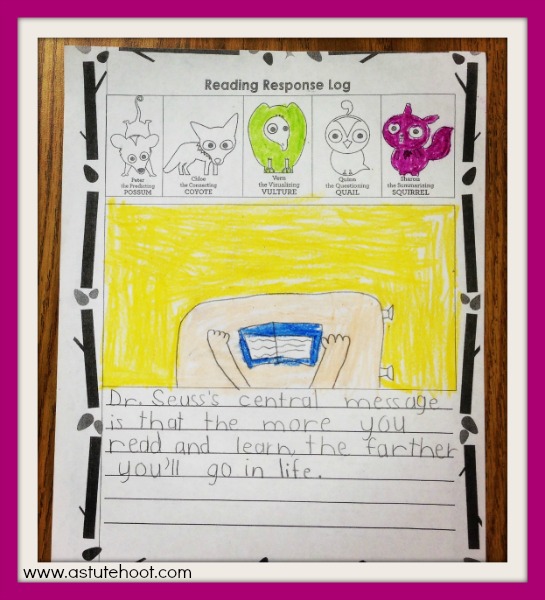
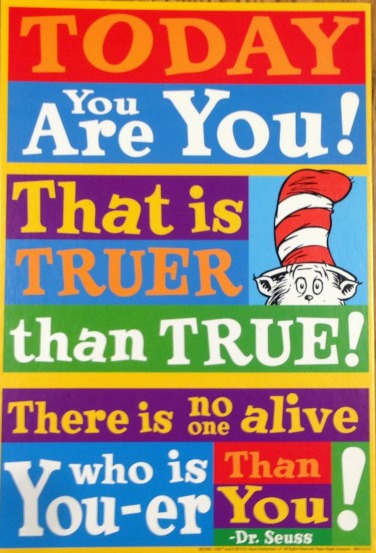
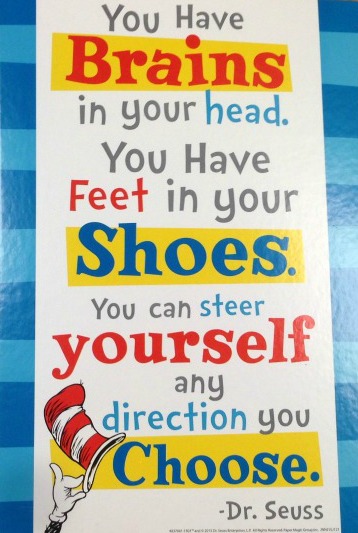
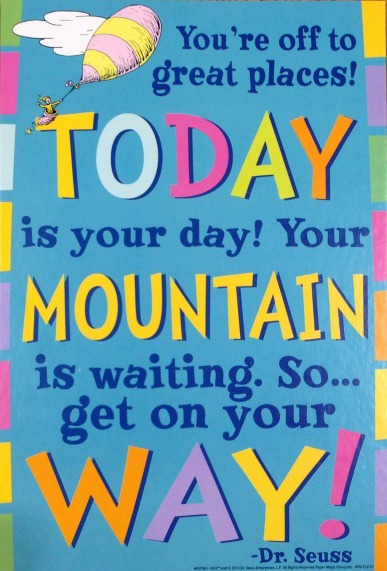
Central message anchor chartI found Dr. Seuss quote posters in Target’s Dollar Section and purchased 4 as a central message culmination activity. I posted the posters around the room and students took a Quote Walk, silently reading each quote to determine Dr. Seuss’ message. They recorded their central messages and themes in their Reading Response Journals. They colored in the strategy animals used during each reading response entry. Sharon the Summarizing Squirrel helped students summarize each central message and theme while Vern the Visualizing Vulture helped them visualize each quote. Check out the quote posters and students’ central message jourmal responses:
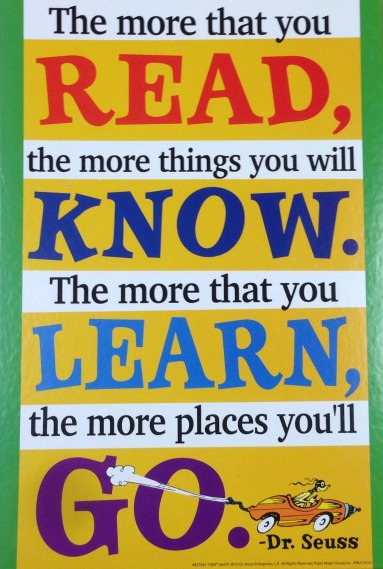
Dr. seuss sign 5.5central message 4.5Dr. Seuss sign 3.5central message 1.5Dr. seuss sign 4.5central message 2.5Dr. Seuss sign 2.5central message 3.5Looking for additional Dr. Seuss activities? Download our FREE Cat in the Hat Snack recipe and read our latest blog, Celebrate Dr. Seuss In Style.  Happy Read Across America week!
Jessica_blog_signature-SMALL

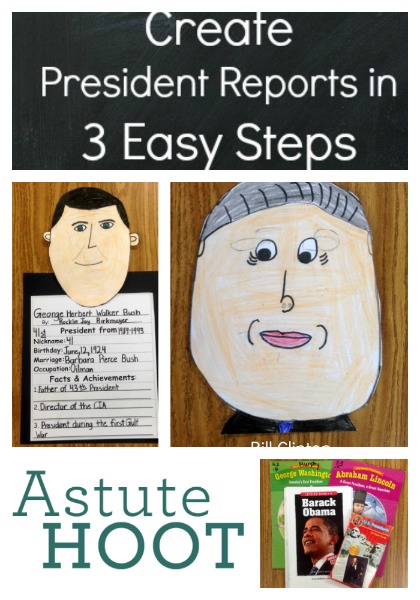
Create President Reports in 3 Easy Steps

Since it was President’s Day on Monday and we are reading and writing biographies, my class studied the life of Barack Obama this week. They loved learning about his childhood, interests, schooling and more. This study prompted them to ask questions about other presidents, so we completed these cute, easy presidential reports. Download this FREE project here.

PicMonkey Collage

Follow these 3 easy steps to create the presidential reports:

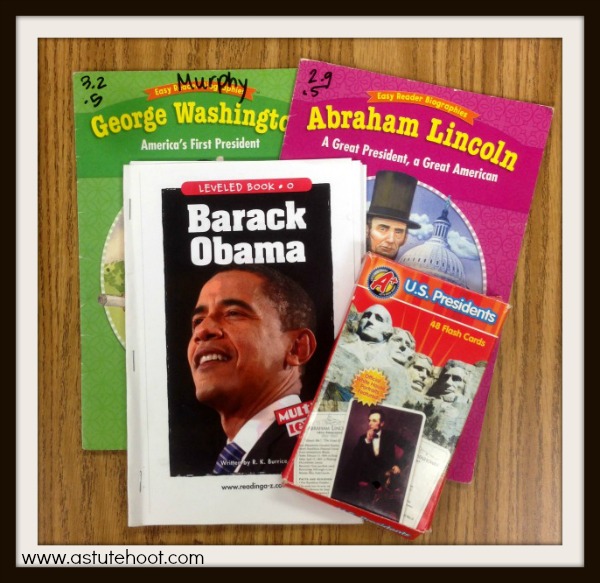
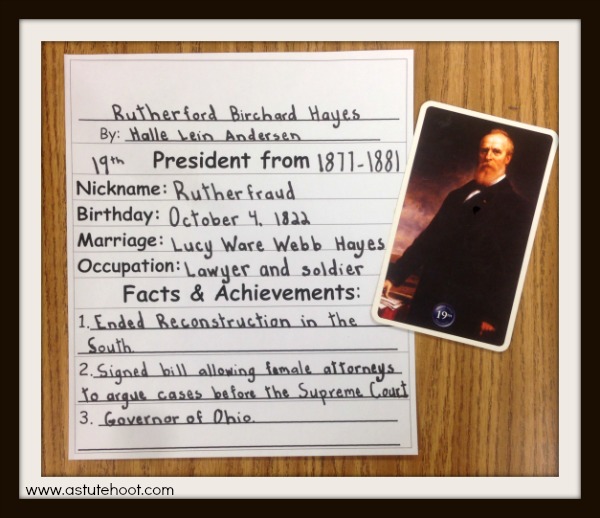
  1. Select appropriate presidential research. I found the presidential fact card deck in the Target dollar section, but also used a variety of leveled text as sources for research to differentiate for all learners. Pre-select the cards, picking presidents that students would find most interesting (cool nicknames, facts, etc.). Remove cards that would be difficult to read and understand. (Remove Nixon as his nickname is “Tricky Dick”.)
    President research
  2. Complete president report. Model how to use information from the fact card or leveled text and think aloud as you go. Then have students complete the research; this is a perfect activity to complete in small groups. Differentiate the report according to students’ needs. Partner students or have students work individually to complete the report.
    Rutherford Hayes
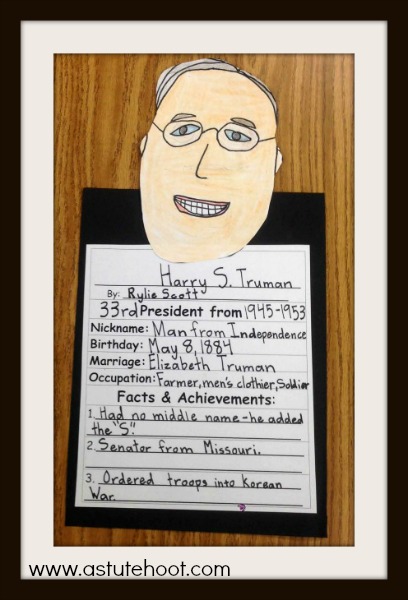
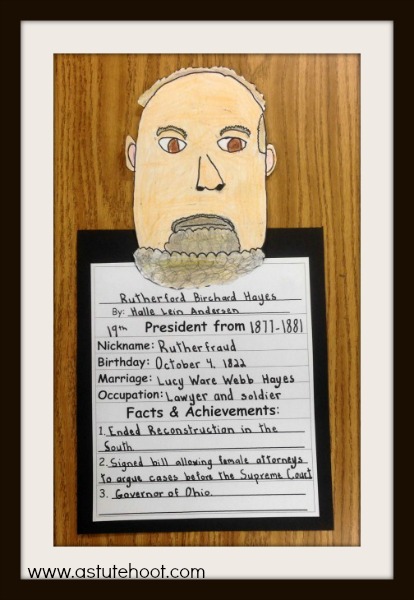
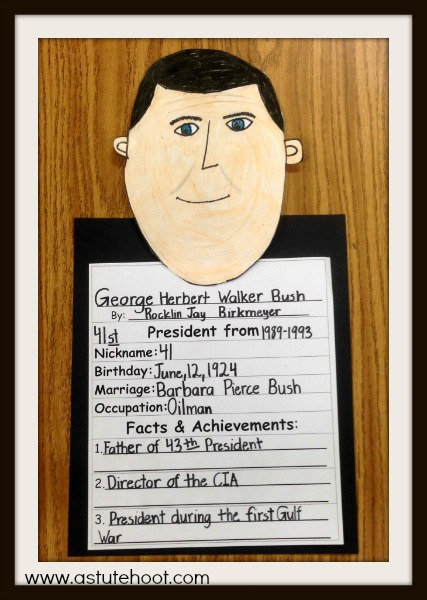
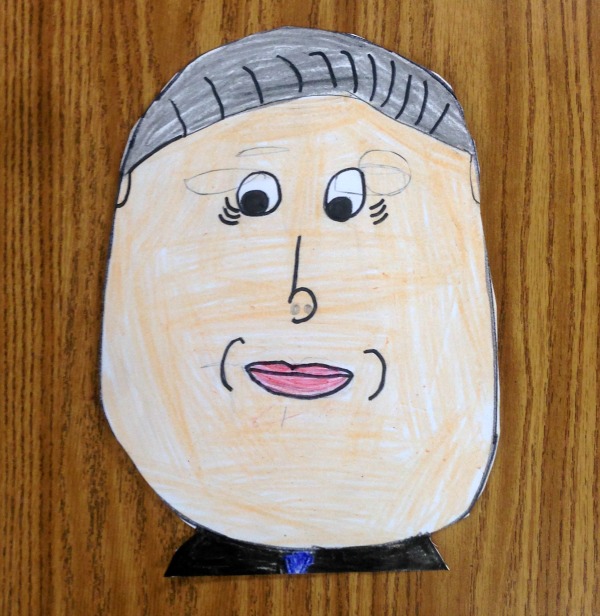
  3. Draw presidential portrait. Give students white paper and have them draw a pencil sketch of selected president. Trace with Sharpie and then color with crayon. Cut out and glue on top of report. You can glue on black construction paper (to look like a suit) and add arms and legs if you desire.
    Harry Truman reportHayes completed reportGeorge Bush completed reportBe sure to share reports with class. Possible discussions include similarities (most were lawyers), differences, occupations, facts and achievements. Your students will love learning more about the presidents!
    Jessica_blog_signature-SMALL

Strengthen Mathematical Understanding in 4 Easy Steps

Mathematical understanding means that students understand the story problem and follow the problem-solving steps. Understanding story problems can be very challenging because it requires multi-step, higher-level thinking processes. Students are required to process several pieces of information before starting any mathematical operations. If students do not understand the problem, they will solve it incorrectly, even if they have a strong repertoire of strategies.  Strengthen your students’ mathematical understanding with these 4 easy steps:

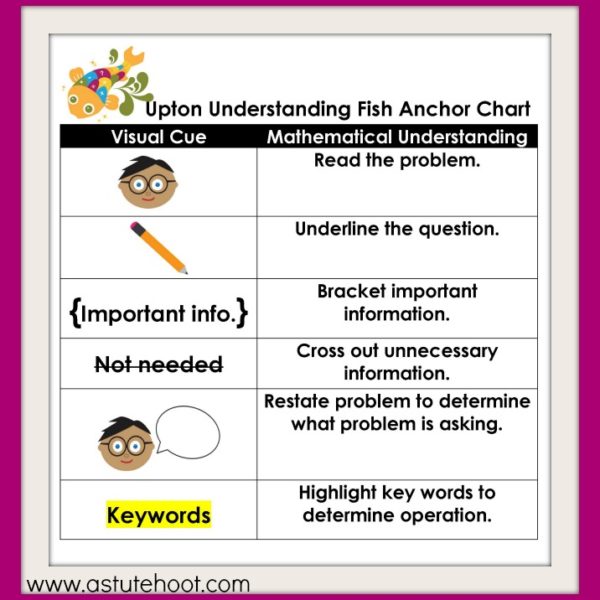
1. Scaffold instruction: Mathematical understanding includes many steps: identify question; identify key information; get rid of erroneous information; determine the operation; solve using an appropriate, efficient strategy. Since mathematical understanding involves so many steps, teachers should teach each step explicitly and introduce the next step after proficiency is demonstrated. This allows the teacher to isolate individual steps first and then gradually integrate the steps together.

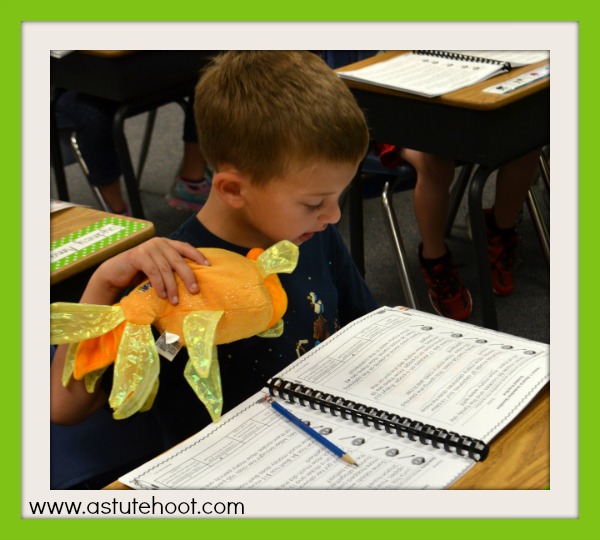
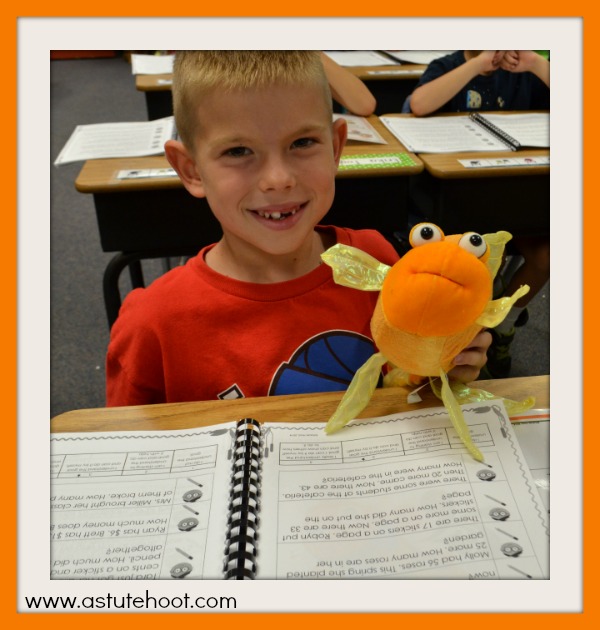
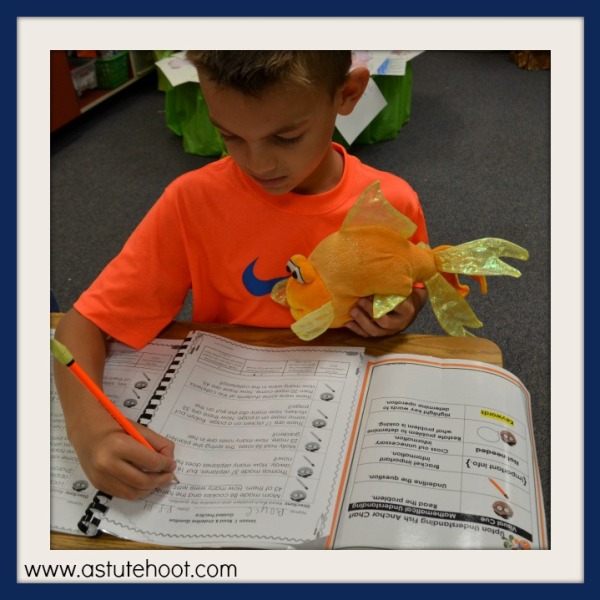
2. Incorporate multi-sensory activities: Allow students to act out the problem and use manipulatives to help students build understanding. In my classroom, students use Upton Understanding Fish to help them complete the problem-solving steps. I purchased a inexpensive, yellow Webkinz fish from Ebay to use as our classroom Upton.

Reading with Upton

During direct instruction, I model each of the problem-solving steps, thinking aloud as I go. I hold Upton right beside me and will often talk to him during my think-alouds. The students think it is funny, but it keeps them engaged. During guided practice, I toss Upton to different students, asking them to help me complete one of the problem-solving steps. Students also take turns using Upton to assist during independent problem-solving time.

Reading with Upton 2

The stuffed Upton fish has become a pivotal piece of my problem-solving instruction because it helps kids feel safe to take risks and discuss problem-solving steps. In fact, a few of my students have even asked their parents for their own Upton as a birthday or Christmas gift.

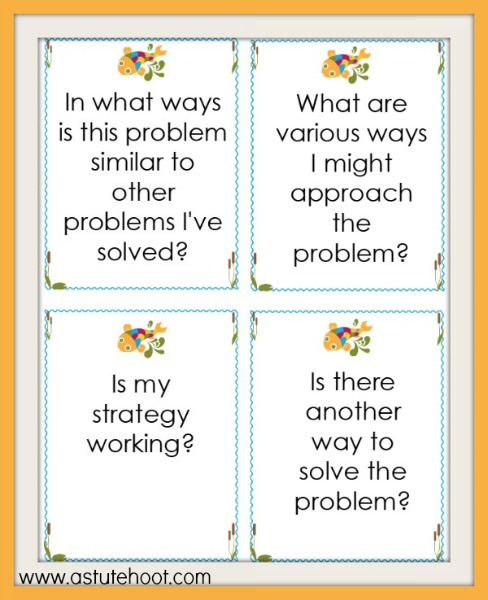
3. Use discussion questions and prompts:Students are more successful at solving math problems when they monitor and reflect upon their thinking and problem-solving steps as they work through problems. We often assume that students know how to thoroughly discuss their mathematical thinking and problem-solving steps, but like an other concept or skill, this must be taught in depth. Teachers must model the self-questioning process and provide multiple opportunities and support for students to practice it until they can use the questioning strategies independently.

I use Upton’s self-reflection questions and peer discussion prompts to facilitate mathematical discussion. I introduce one prompt or question at a time and add additional prompts in subsequent lessons.

MathProblemSolvingSelfReflectionandPeerDiscussionQuestions.pdf-6 (2)

During lunch (before our problem-solving time), I leave the new prompt or question right by Upton as if he is presenting it to the class. When I pick the kids up for lunch, I tell them that Upton left us something and they get so excited to read his new question or prompt.

4. Provide anchor charts: Post the problem-solving steps in a prominent place in classroom. I add a visual cue for each step to promote understanding. As you teach problem-solving, refer to these posted steps and encourage students to do so when solving independently as well.

Upton anchor chart

Download our Upton Understanding Fish problem-solving unit and accompanying self-reflection and peer discussion questions and prompts to help build mathematical understanding in your classroom.

Jessica_blog_signature-SMALL


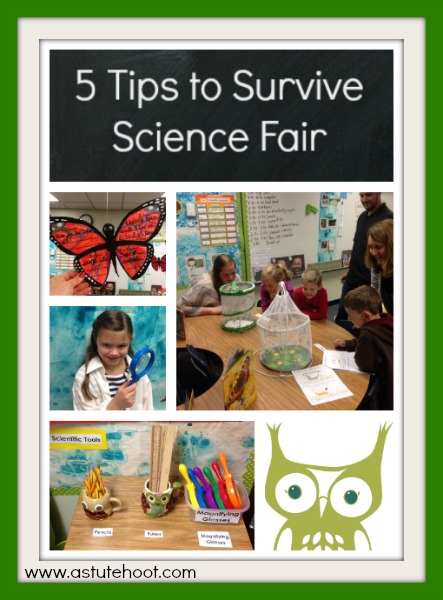
5 Tips to Survive Science Fair

The Science Fair usually brings a mix of emotions. Students love the hands-on learning but for teachers, the Science Fair can be nightmare. What project(s) should the class do? How can I organize students’ work samples? How do I involve parents?  Use these 5 tried-and-true tips to survive the Science Fair.

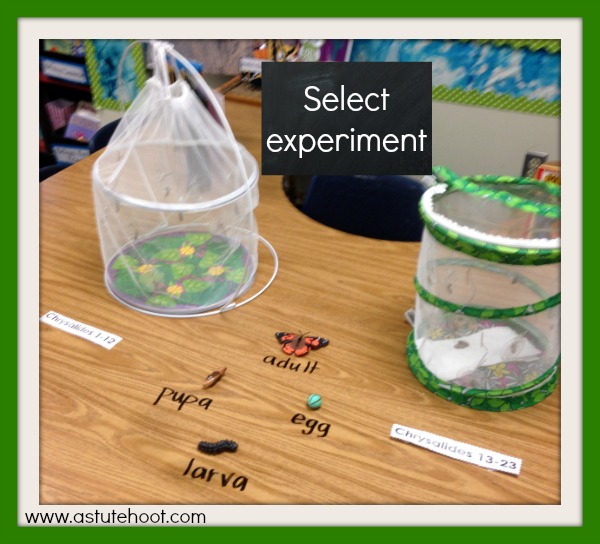
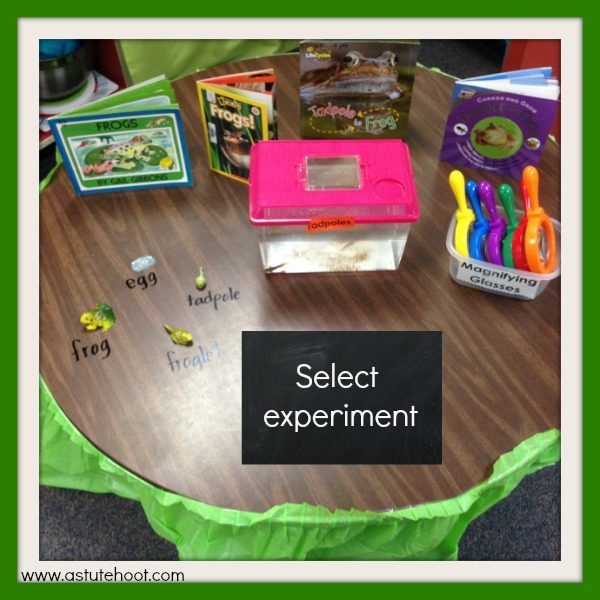
PicMonkey Collage1. Select experiment: Since my students are required to learn the life cycle process, I bought caterpillar and tadpoles for them to study. I also picked a variety of leveled text on butterflies and frogs to use during my guided reading groups to make it a cross-curricular project.  It may to tempting to choose an experiment that just seems fun and interesting, but always be sure that it aligns to your grade level standards and curriculum.  This helps to extend learning and create a richer learning experience.

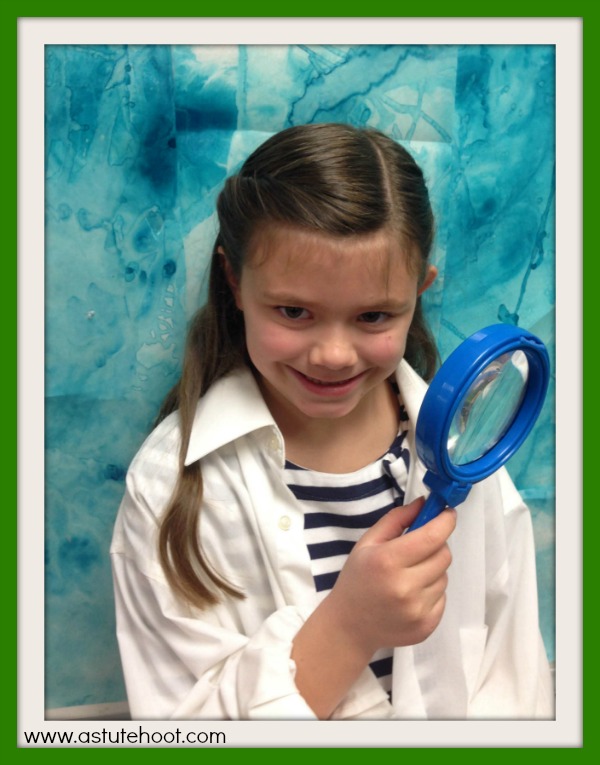
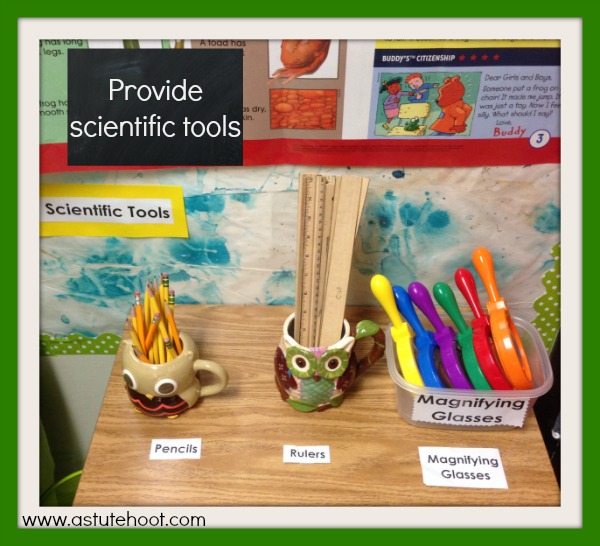
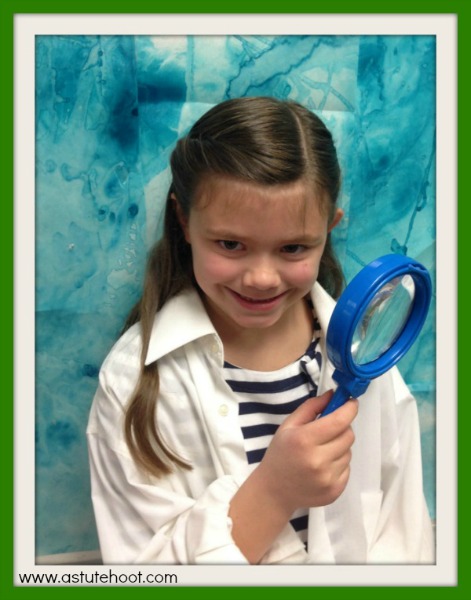
ButterfliesFrogs2. Provide scientific tools: Use a variety of hands-on tools and materials. Allow students to use magnifying glasses and rulers and they observe their specimens. I bought a few men’s white button-down dress shirts and called them “lab coats’ which the students absolutely loved. They felt like real scientists!

Science tools 1.5Lab coats 3


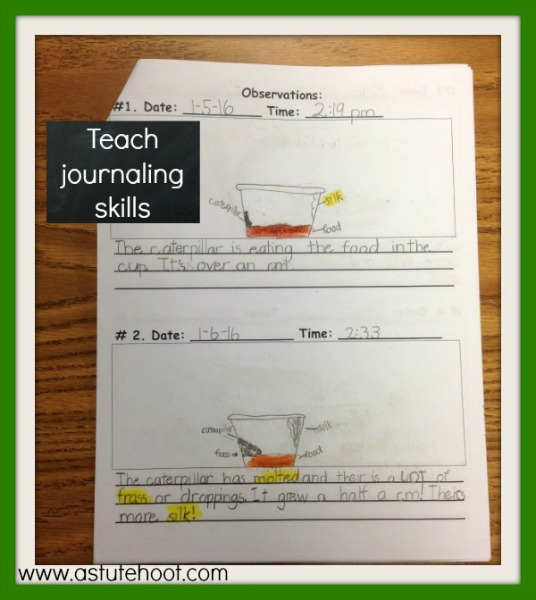
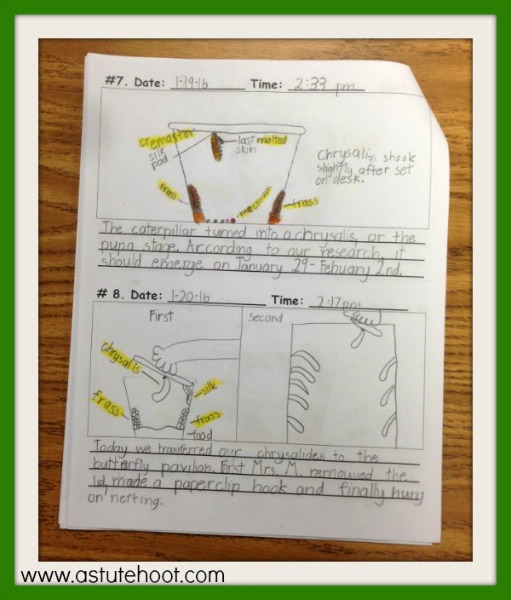
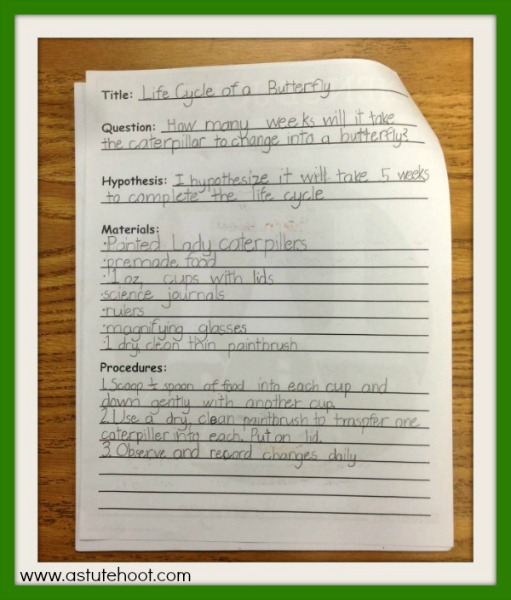
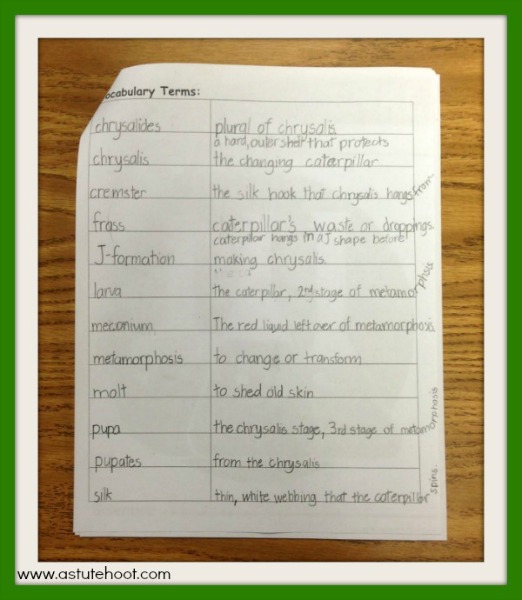
3. Teach journaling skills: The Science Fair is the perfect opportunity to teach vital journaling skills. My students learned how to tell time to the nearest minute, write a detailed observation in complete sentences, and draw a scientific diagram. They also highlighted new vocabulary terms which they compiled into a glossary. Plus, I used their observations as writing grades. Download this journal here

.

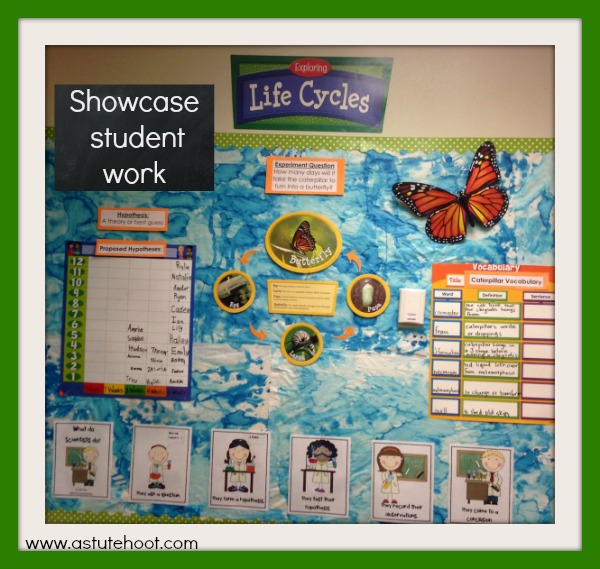
Journal 2.5Journal 3.5Butterfly procedures 1.5Science glossary 1.54. Showcase students’ work: Dedicate a bulletin board or showcase table to display students’ learning and scientific work samples. Creating a portfolio of their work is another great option.

Showcase student workMy students made these “Meet the Scientists” for our Science Fair night. They were a huge hit!
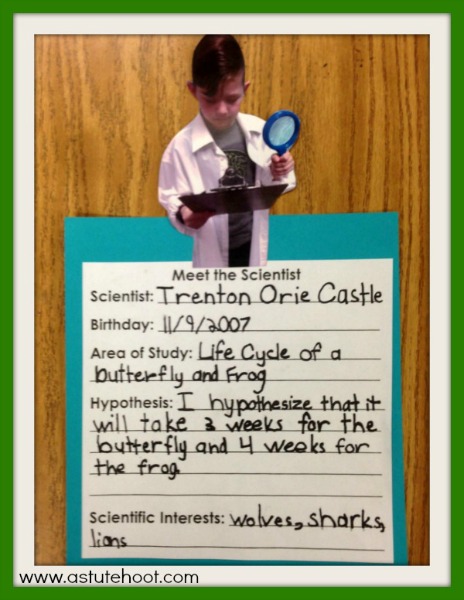
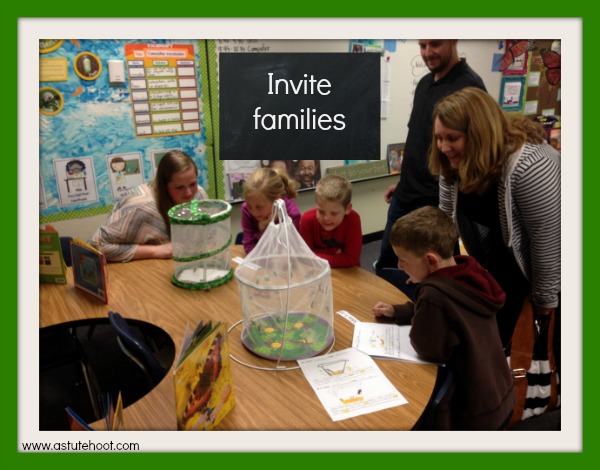
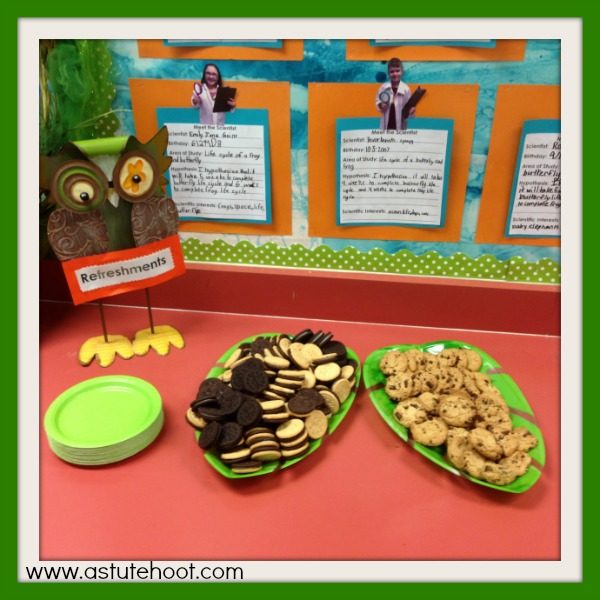
Meet the Scientist 1.55. Invite families: Have students create a formal invitation inviting families to the Science Fair. This is a great opportunity for students to share their new learning; parents are always so proud and impressed. You may also want to consider providing probing questions for parents to ask their children and an activity for children to showcase their skills. Be sure to provide refreshments (I bought inexpensive cookies from Target).

Invite familiesRefreshmentsI’d love to hear your great Science Fair ideas!
Jessica_blog_signature-SMALL

Create Write-On, Wipe-Off Problem-Solving Journals

Problem-solving plays an important role in my daily math instruction. Students use pre-made journals to help them complete the problem-solving steps, solve the problem in 2 ways, explain their thinking and rate themselves on a learning scale. These journals track students’ progress with mathematical understanding, strategy selection and application. They also serve as an effective assessment tool. I decided to make a write-on, wipe-off version for students to use during math centers. Follow these 4 easy steps to make them for your classroom, too!

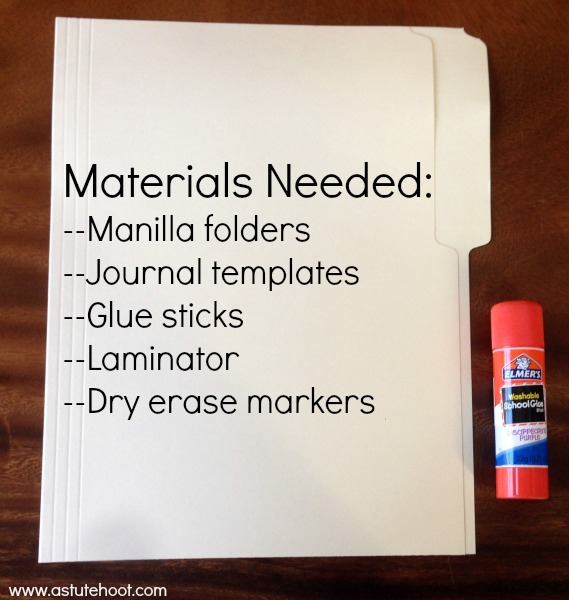
1. Gather materials: You will need a class set of manila folders, problem-solving journal templates, glue sticks, a laminator and dry erase markers.
Materials

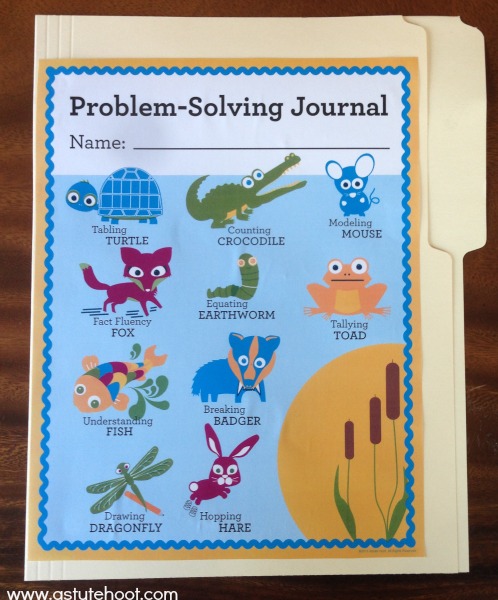
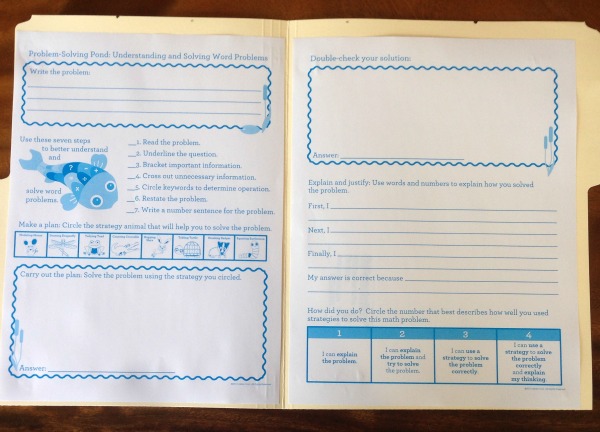
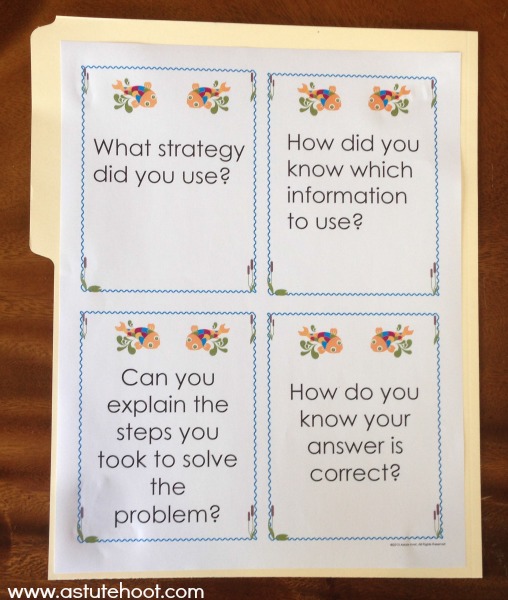
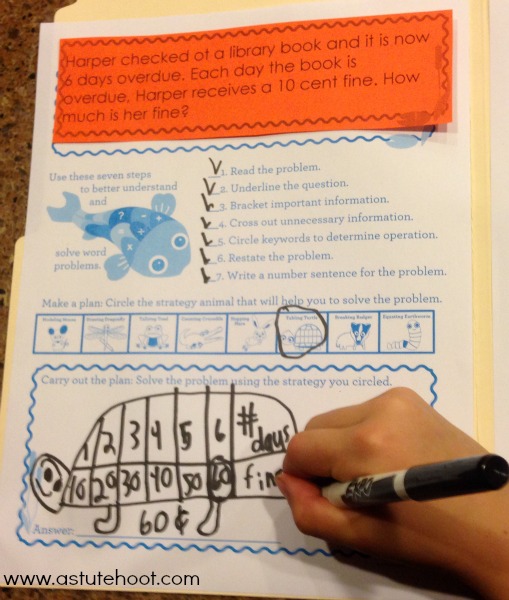
2. Prepare folders: Glue on the front cover, problem-solving pages on the inside, and the discussion prompts on the back. Laminate and cut out (a perfect job for a parent volunteer).

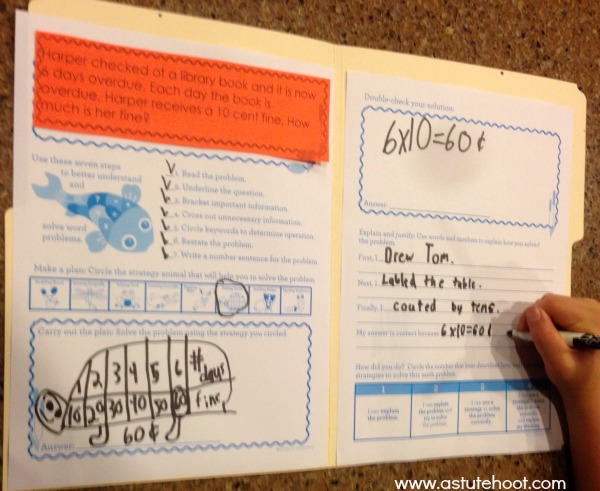
Journal front 1.5Inside of problem solving journalBack of problem solving journal mat

3. Select appropriate story problems: I use differentiated story problems during math instruction and color code to keep them organized. An extensive story problem bank is included in our Problem-Solving Essentials Bundle.
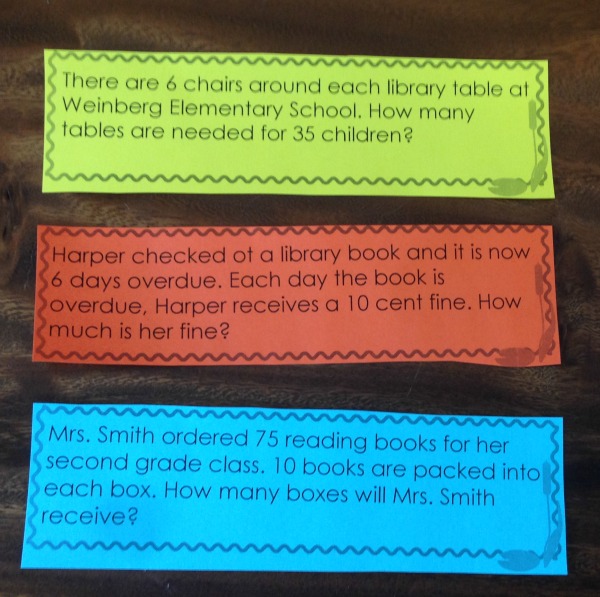
Word problems

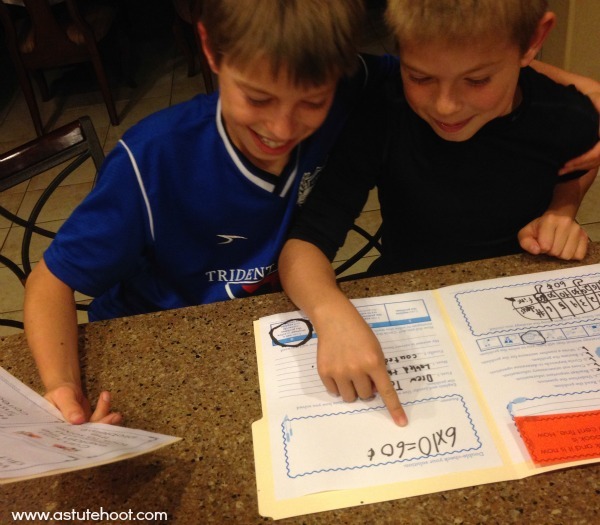
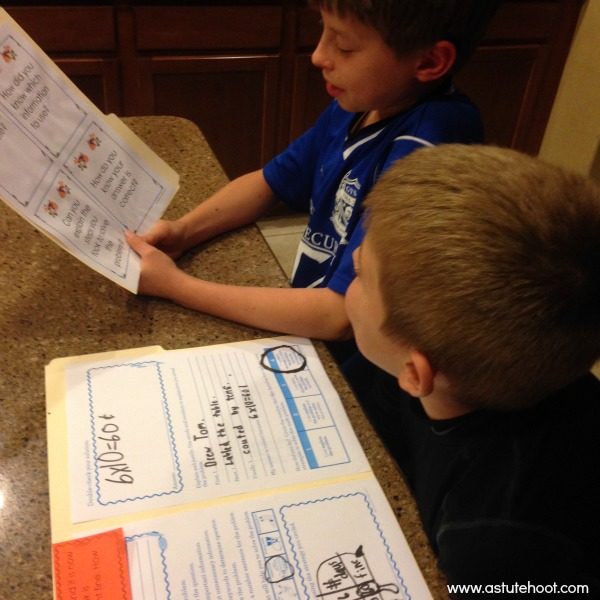
4. Model procedures and provide practice: Explain how to use the write-on, wipe-off problem-solving journals. Model how to use a dry erase marker to complete the journal. Select a partner to use the discussion prompts, thinking aloud as you go. Practice using the journals during whole group instruction, roving to monitor student understanding. As students demonstrate understanding, incorporate these journals into math center time, either at an adult-led center or an independent math center.

Page 1.5Inside of journal

Mathematical discussion 2.75Mathematical discussion 3.75

Download our Math Intervention Problem-Solving Essentials Bundle for over 200 pages of lessons, activities, worksheets, printables, everything you need for comprehensive problem-solving instruction during math intervention, special education and general education.

Jessica_blog_signature-SMALL


Sign up for
blog updates

© 2020 – Astute Hoot. All rights reserved.